What Is a Controls Engineer? Skills, Salary, and How to Become One
9 min read · Last updated June 1, 2026
What does a controls engineer do, how much do they earn, and how do you get into the field? This guide covers the full picture: skills, salary data, the US job market, and the best paths in.
Almost every machine that moves on its own has a controls engineer behind it.
The bottling line that fills, caps, and labels thousands of ketchup bottles an hour. The water treatment plant that keeps your tap water at the right pressure around the clock. The HVAC system that keeps a building at a steady temperature without anyone touching a thermostat.
None of that runs by accident. Somewhere, someone wrote the logic that tells those machines what to do, when to do it, and what to do when something goes wrong.
That person is a controls engineer. And despite being one of the most important roles in manufacturing, it's also one of the least understood.
This article covers what controls engineers actually do, where they work, the skills the job demands, and the paths people take to get into the field.
What Is a Controls Engineer?
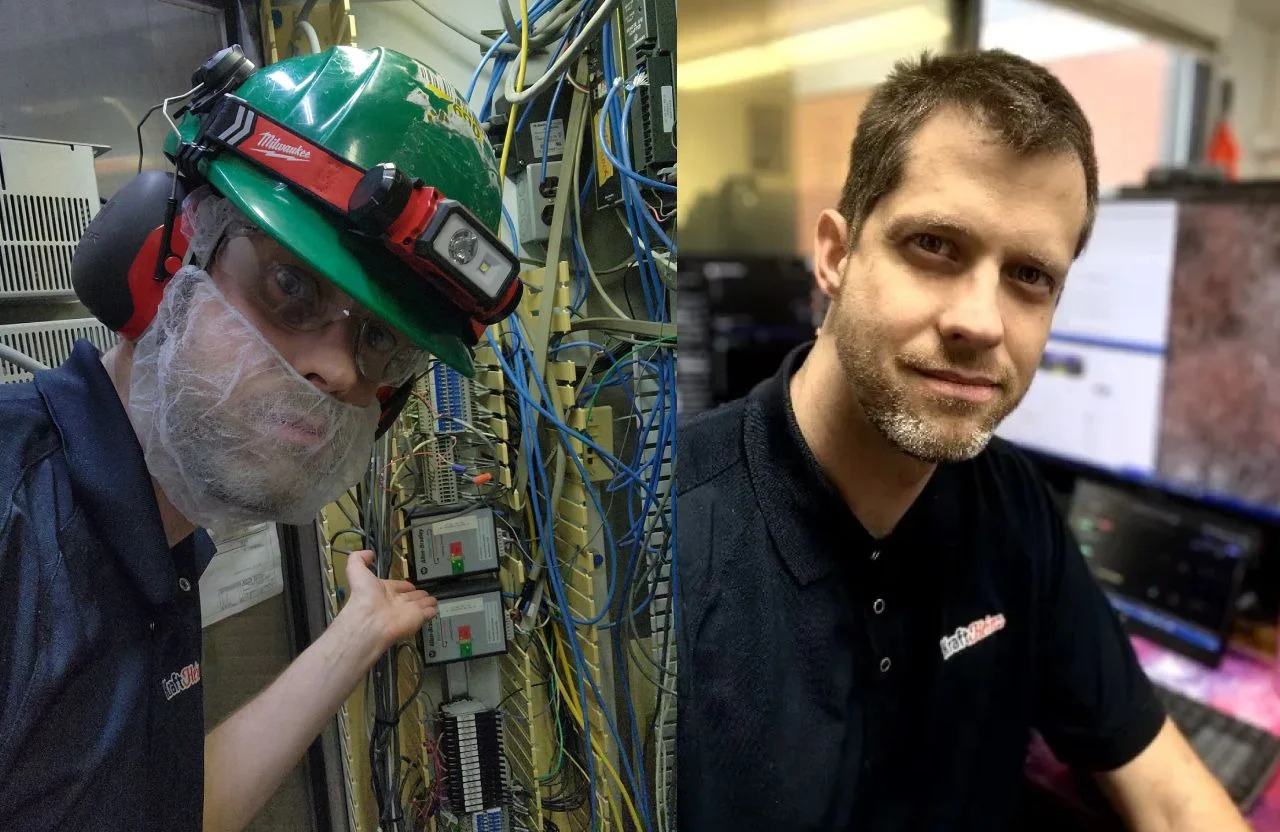
This is Eric, a controls engineer at Kraft Heinz we interviewed for the article!
A controls engineer designs and programs the systems that make machines run automatically. It means taking a process — a conveyor belt, a pump, an entire production line — and building the systems that control it.
The controls engineer decides what signals need to be read on a machine, which sensors are needed, and what to do based on those signals.
At Blitzpanel, our controls engineers design and build electrical control panels for factories across the country. If you're interested in working with us, reach out here.
What Does A Controls Engineer Do?
Here's what a typical day-to-day can look like for a controls engineer:
Design the system. The controls engineer figures out what a machine needs to sense and control. This is where an I/O list comes in: every signal going into or out of the controller is tracked.
Specify the hardware. Which PLC, how many input and output cards, what drives, what power supplies.
Write the logic. Using the PLC's logic (usually ladder logic, function blocks, or structured text), the engineer writes the rules that govern the machine: when a motor starts, what happens when a sensor trips, how the system recovers from a fault.
Build the operator interface. The HMI (Human-Machine Interface) is the screen an operator uses to run the machine. The controls engineer designs what that screen shows, what buttons it has, and what alarms pop up when something needs attention.
Commission and troubleshoot. Once the panel is built and installed, the controls engineer is on-site preparing it: testing every signal, tuning the logic, and chasing down the inevitable problems that only show up when equipment starts moving. This is the part that happens on a plant floor, not at a desk. Safe panel design — including things like disconnect boxes — is part of what makes commissioning possible without injury.
Skills That Matter
The job sits at the intersection of electrical, software, and mechanical work, so the skill set is broad. Here are some core skills that we see or hear mentioned:
Technical Skills:
- PLC programming. Knowing at least one major platform (Allen-Bradley and Siemens dominate) is essential, and the concepts transfer between brands.
- Control theory fundamentals. Understanding feedback, PID loops, and how a system responds to its own corrections.
- Reading electrical schematics. You can't troubleshoot a panel you can't read.
- HMI and SCADA development. Building the screens and supervisory systems people rely on.
- Networking. Knowing how devices talk to each other over protocols like Ethernet/IP and Modbus.
Soft Skills:
- Communication. The skill that matters most. You're constantly explaining technical problems to people who aren't technical: telling a plant manager why the line stopped, or walking a maintenance tech through a fix over the phone.
- Patience. Commissioning means long hours chasing problems that only appear once equipment starts moving, and a fix that should take five minutes can take all day.
- Adaptability. The situation on a production floor might change in an instant. You have to drop the task you planned for and react when a line goes down.
- Documentation. A clean drawing and a current I/O list save the next person hours, even if that next person is you.
We interviewed Eric, a controls engineer at Kraft Heinz for this article. He mentioned that a controls engineer's skillset should be "one mile wide and one inch deep." It's a compliment and a warning at the same time. You're expected to know a little about electrical, a little about mechanical, a little about networking, a little about software, and enough about the process itself to talk to the people who run it.
How to Become a Controls Engineer
There's no single required path into controls. The field cares more about whether you can make a machine work than about exactly how you learned to.
When we asked current engineers what they'd tell someone eyeing the field, the answers lined up. Eric put it simply: "go do a community college mechatronics program."
It's not the advice you'd expect. The instinct is to chase a four-year electrical engineering degree. But for getting into controls specifically, a mechatronics program is hard to beat, for a few reasons:
- It's hands-on from day one. Mechatronics sits right on top of the actual job: PLCs, motors, sensors, drives, and wiring. You're working with equipment instead of reading about it.
- It's fast and cheap. Two years and a fraction of the cost.
- It maps to the work. "Mechatronics" is just electrical plus mechanical plus controls. The curriculum is built around the work you'll actually do.
- It keeps doors open. If you decide you want the four-year degree later, the hands-on foundation makes the theory easier, and plenty of programs roll into a bachelor's.
No Degree? Not a Dealbreaker.
Controls engineering is also a field that is open to those without a degree, as long as you have some technical training. Plenty of controls engineers never got a degree, and they worked their way in from a hands-on trade.
The story might sound like this: you start as an electrician or maintenance tech, you're on the floor when machines break, and those machines are full of PLCs. You start reading the ladder logic to find out why a line stopped. You get tapped by a senior engineer to make a small change, then a bigger one. Eventually you're the person who understands the control system, and the title catches up to the work.
Employers lean into this. Plenty of maintenance roles are posted specifically to train someone with basic ladder logic into the controls specialist, and many controls jobs will take years of experience in place of a degree.
If You Already Have a Degree
The advice we heard is to go work for a system integrator. These are companies that get hired to build control systems for other businesses, so you're always jumping onto a new project.
Another route is to take an entry job near the equipment — manufacturing, internships, even maintenance roles that are open to grads — and build proof on the side with a cheap PLC and some free programming tools.
Basically, a degree will help you get past HR, but your familiarity with PLCs determines whether you get the job.
The US Controls Engineer Job Market
A Few Numbers Worth Knowing As Of 2026
- Manufacturing has been sitting on 440,000 to 510,000 open jobs through early 2026.
- For specialized roles like controls, demand increases year-over-year.
- Reshoring is part of the reason.
- Announced manufacturing job creation jumped 53% in a single year.
- Semiconductor manufacturing accounted for 35% of those jobs.
- 88% of the 244,000 jobs announced in 2024 were classified as high-tech or medium-tech manufacturing.
- Deloitte and the Manufacturing Institute project up to 1.9 million unfilled manufacturing jobs by 2033, with controls and automation among the hardest-hit specializations.
TL;DR: Demand is high, supply is low, and the gap isn't closing. If you can do this job, someone is trying to hire you. And that's only becoming more true over the next decade.
In fact, Blitzpanel is currently hiring controls engineers to design and build control panels for factories across America. If you're looking for a new opportunity or interested in learning more, reach out here.
What Does It Pay?
Pay data differs across sources, industries, and experience. This is some data from PayScale, ZipRecruiter, and Glassdoor.
- PayScale: average around $90,000.
- ZipRecruiter: average around $97,000, middle 50% earning $84k–$108k, top earners hitting $121k.
- Glassdoor: average around $128,000, top earners reporting up to $188,000.
Different industries also compensate differently. We looked at controls engineer job postings from three different sectors:
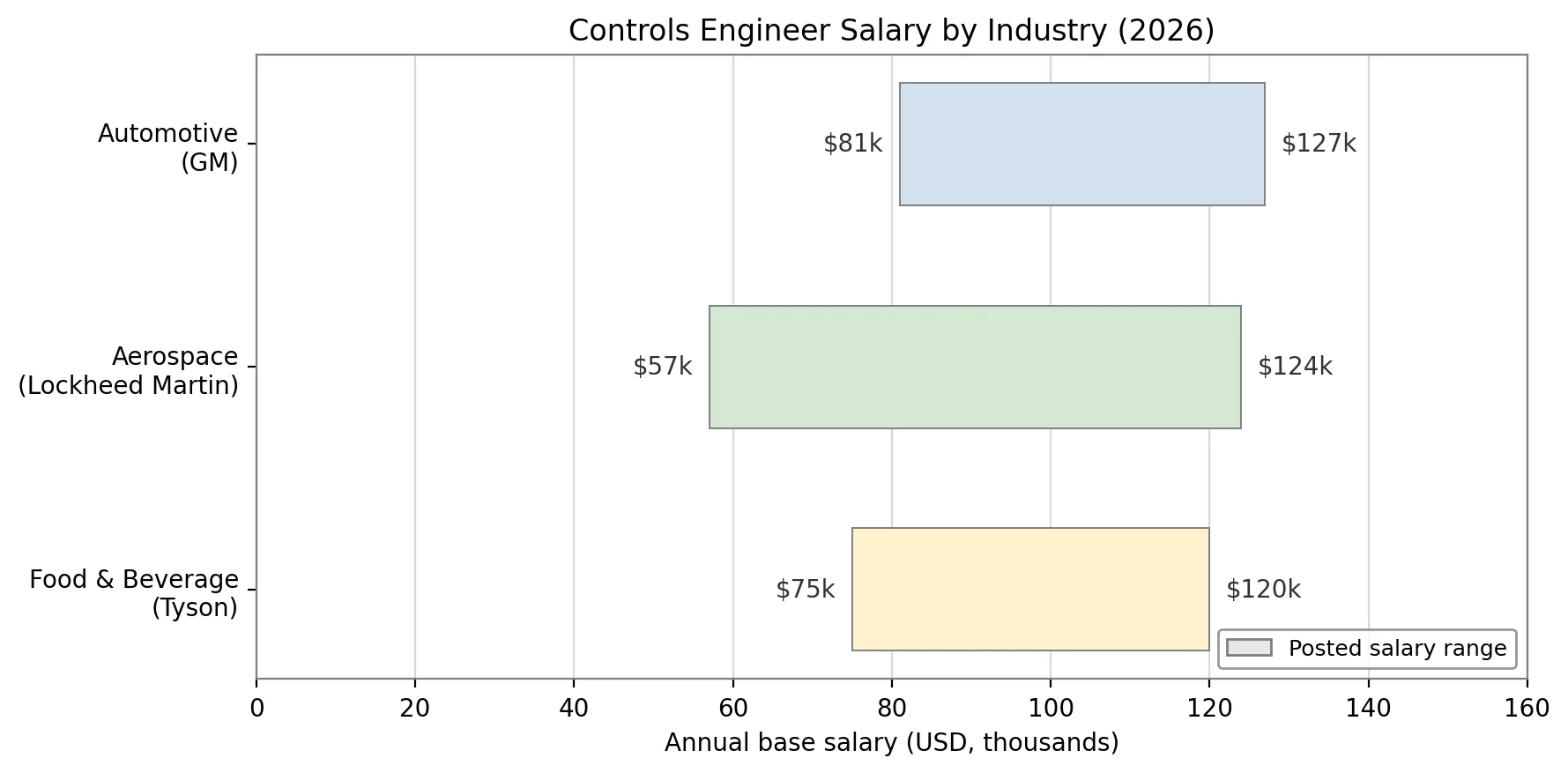
Here's what salary progression might look like as a controls engineer.
- Entry-level: around $60k–$70k
- Mid-career: around $85k–$95k
- Experienced: around $100k–$110k
- Senior and specialized: $140,000+
Salary growth tends to soft-cap around $150,000 for engineering. Management or ownership is the typical path to break past this ceiling.
Conclusion
Controls engineers are the reason modern automation works. They bridge hardware and software, and get called when a machine has to run on its own.
The field is growing. More of the world gets automated every year, the pay rises with skill, and the demand isn't slowing down.
As a controls engineer, you'd build things that move real objects in the real world, then watch them run. The bottling line you commissioned is filling bottles tonight. The water system you programmed is holding pressure while a city sleeps.
If that's the kind of work you want to do, Blitzpanel is hiring. We build control panels and we're always looking for people who want to get their hands on equipment. Reach out and let's talk →
FAQ
Do I need a degree to become a controls engineer?
It helps, but it's not a hard requirement everywhere. A degree gets you past resume filters and gives you control theory you'd otherwise have to learn the hard way. But the field genuinely respects hands-on competence, and plenty of strong controls engineers came up through the trades or taught themselves. What you can't skip is real time with real equipment.
Will AI replace controls engineers?
Unlikely. AI is strong at screen-based work like drafting logic and analyzing data, and weak at the on-site, physical troubleshooting that defines this job. But the engineers who excel will be the ones who use AI as a tool rather than ignore it.
What is Blitzpanel?
Blitzpanel designs and builds custom electrical control panels. We work with engineers, OEMs, and integrators, providing expert engineering expertise and manufacturing support so panels are built right, documented properly, and delivered fast. Book a call with us here.
Which PLC platform should I learn first?
Allen-Bradley (Rockwell) and Siemens dominate the market, so start with whichever one is common in the industry or region you want to work in. The good news is that the underlying concepts transfer between brands, so the second platform is far easier than the first.
Is this a desk job or a hands-on job?
Both, and the mix depends on the role. Some weeks are design and programming at a desk. Others are spent with a laptop balanced on a ladder, commissioning a machine on a plant floor. If you want one or the other exclusively, look closely at the specific job before you take it.
How do I get started with no experience?
Buy a used PLC, wire up a small project, and build something that actually runs. Then target entry-level titles like Automation Technician or Field Service Engineer that put you next to real equipment. Hands-on experience compounds faster than anything you can put on paper.
Glossary
PLC (Programmable Logic Controller). The industrial computer that runs the control logic. The brain of the system.
HMI (Human-Machine Interface). The screen an operator uses to run and monitor the machine.
SCADA (Supervisory Control and Data Acquisition). A higher-level system for monitoring and controlling processes across a whole plant or site, often from a central location.
DCS (Distributed Control System). Similar in spirit to SCADA, used for large continuous processes like refineries and chemical plants where control is spread across many controllers.
I/O list (Input/Output list). A row-by-row inventory of every signal going into or out of the controller. The backbone document of a controls project.
Ladder logic. A common PLC programming language that visually resembles a relay wiring diagram. One of several languages, alongside function blocks and structured text.
PID loop (Proportional-Integral-Derivative). A control method that continuously adjusts an output to hold a process at a target value, like keeping a tank at a set temperature.
VFD / drive (Variable Frequency Drive). A device that controls the speed of an electric motor by varying the power it receives.
Ethernet/IP and Modbus. Common industrial communication protocols. The languages devices use to talk to each other and to the PLC.
Commissioning. The on-site process of bringing a finished panel and machine to life: testing every signal, tuning the logic, and fixing the problems that only appear once equipment starts moving.
Tag. A named reference for a signal or value in the PLC program (for example, Motor_1_Run). What programmers write logic against instead of raw addresses.
Resources
Build Your Control Panel
Start a project with Blitzpanel →