Allen-Bradley vs Siemens PLCs: How To Choose
8 min read · Last updated May 25, 2026
Comparing Allen-Bradley and Siemens PLCs? This guide breaks down hardware, software, cost, and support differences to help you pick the right PLC platform for your control panel project.
2 companies run ~55% of factories in North America.
Siemens and Allen-Bradley are in a battle to control the pumps, sensors, and robotic arms of America's industry. They make PLCs, or programmable logic controllers, devices that serve as the brains of industrial electronics.
It's a pretty high-stakes decision to pick which company gets to run your factory. Different hardware, pricing, protocols. And a super high switching cost. Once you pick one, you're kind of locked in.
This article will help you decide which to put in your control panel.
A Quick Lay of the Land
| Allen-Bradley | Siemens | |
|---|---|---|
| Made by | Rockwell Automation | Siemens |
| Strongest in | North America | Europe, Asia, most of the world |
| Market share | ~40% of US & Canada | ~35–40% globally |
| Big-system model | ControlLogix | S7-1500 |
| Small-system model | CompactLogix | S7-1200 |
| Software | Studio 5000 | TIA Portal |
Both companies make the full kit: the controller, the parts that plug into it, the software, etc. Either brand can run a single small machine or an entire plant, so their capabilities are not usually the biggest factor.
Allen-Bradley, owned by Rockwell, has 40% of the U.S. and Canadian market. So if you walk into a Midwestern factory, odds are the panels are Allen-Bradley. Siemens is a global leader with around 35–40% of the global market. It's dominant in Europe and Asia, but still growing in North America.
Whereas sourcing either brand's PLCs anywhere in the world is not a major issue, finding controls engineering talent for AB vs Siemens will vary in difficulty depending on geography.
Hardware Differences
Allen-Bradley generally makes you buy its whole stack: the chassis, a power supply, the processor, input/output cards that wire out to sensors and motors (tracked in your I/O list), and communication cards that connect it to the network.
Siemens is more flexible and runs off standard parts. Its modern controller clips onto a standard rail instead of a proprietary frame and runs off any standard 24V power supply. This makes it noticeably cheaper to set up on a small project.
Allen-Bradley and Siemens both communicate using different protocols.
| Allen-Bradley (American) | Siemens (European) | |
|---|---|---|
| Main protocol (Ethernet-based) | EtherNet/IP | Profinet |
| Older protocols still in use | ControlNet · DeviceNet | Profibus · ASi |
| Neutral protocols both support (for IT & data) | OPC UA · Modbus TCP · plain TCP/IP | OPC UA · Modbus TCP · plain TCP/IP |
| Network hardware cost | Premium-priced; may need add-on comm modules | Lower; runs on standard Ethernet parts |
Note: Siemens' Profinet runs on Ethernet with a different protocol layered on top.
For overall cost, Siemens tends to come in lower for equivalent capability, especially at the small-to-mid tier. Allen-Bradley can charge a premium in North America, where its market position lets it.
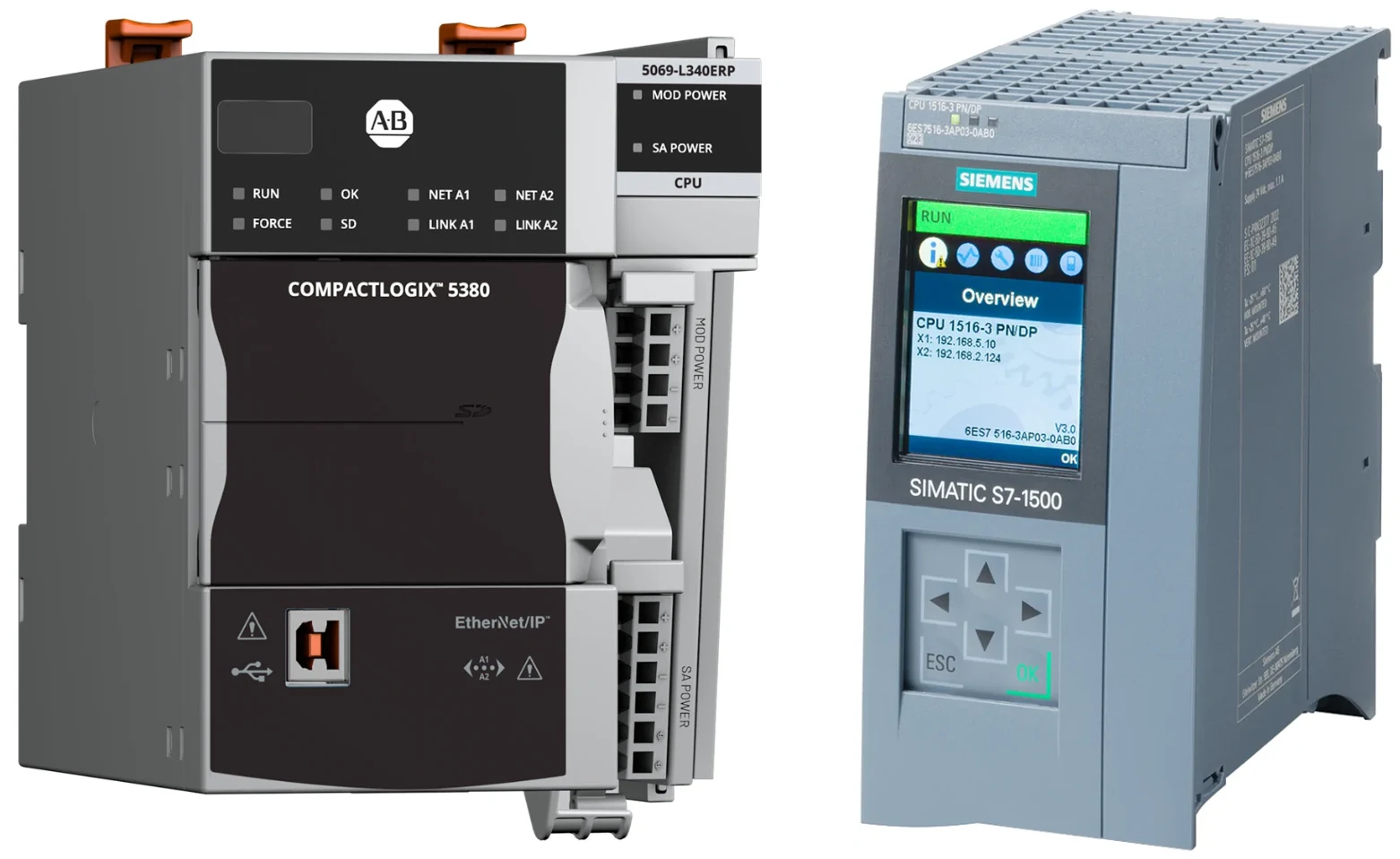
Here's a comparison between a popular PLC from both brands:
| ControlLogix 5380 / 5580 (Allen-Bradley) | S7-1500 (Siemens) | |
|---|---|---|
| Best for | Large / plant-wide control | Large / complex automation |
| Architecture | Chassis + backplane (buy the stack) | Rail-mount, modular (standard parts) |
| Max memory | Up to ~40 MB (5580 tier) | Up to ~10 MB (top CPU) |
| Modules per rack | Up to ~31 | Up to 31 (+ remote racks) |
| Processing speed | Sub-microsecond (5580) | As fast as ~1 ns/instruction (top) |
| Integrated motion | Strong multi-axis coordination | PLCopen motion; deterministic Profinet |
| Main protocol | EtherNet/IP (1 Gbps) | Profinet |
| Entry price (CPU) | Higher (~$5,000–9,000) | Lower (~$2,500–3,500) |
Software: Studio 5000 vs TIA Portal
The other half of a PLC is the software. Both brands have their own, and they work nothing alike.
Studio 5000, Allen-Bradley's software, is generally the more beginner-friendly option. New engineers tend to find it more intuitive. The key reason for this is its "tag-based" model, which makes you label data with plain names like TankTemperature instead of memory addresses.
TIA Portal, by Siemens, is technically demanding, but more versatile. Controller logic, HMI development, drive development, and network design are all bundled into TIA, which is an advantage for massive projects with lots of moving parts. It's more capable and configurable than Studio 5000, but less forgiving if you don't know what you're doing.
The ability to edit a program that's running is a big difference. TIA usually lets you push updates on a program while the machine is still running, whereas Studio 5000 requires a full download for code changes, so the system has to shut down.
Software licensing. Studio 5000 licenses typically run $12,000–$15,000 for a full development seat. TIA Portal pricing varies more widely based on which packages you need, but a comparable setup is in the same range.
| Studio 5000 (Allen-Bradley) | TIA Portal (Siemens) | |
|---|---|---|
| Ease of use | More intuitive, easy to start | Steeper, less forgiving |
| All-in-one workspace | Mainly controller logic | Logic, screens, drives & network |
| Editing a running line | Often a full reload (downtime) | Update one block, line keeps running |
| Cost | Full License; ~$12,000–$15,000 | Per-Module Pricing; ~$12,000–$15,000 |
Support Cost
On support, Siemens generally includes standard technical support at no additional cost. Rockwell charges for technical support depending on your hardware. For a small shop, this can be a meaningful difference. If you have an established Rockwell relationship, it usually isn't a deciding factor.
But hardware and support costs are not really the biggest considerations. The important ones are almost always:
- What your maintenance team already knows
- What spare parts you already stock
- What your customer or end client requires
- What protocols your existing equipment speaks
So a "cheaper" PLC that your team can't troubleshoot at 2 AM is not actually cheaper.
How the Size of Your Project Plays a Role
The importance of deciding your PLC brand scales with the size of your project. The bigger the project, the larger the switching cost. Changing PLC brands means rebuying software, retraining staff, and rewiring and retesting equipment. The costs to swap are so high that it's effectively forcing brand loyalty. If this is intimidating, we can walk you through what might be best for your project. Just email [email protected].
Making Your Choice
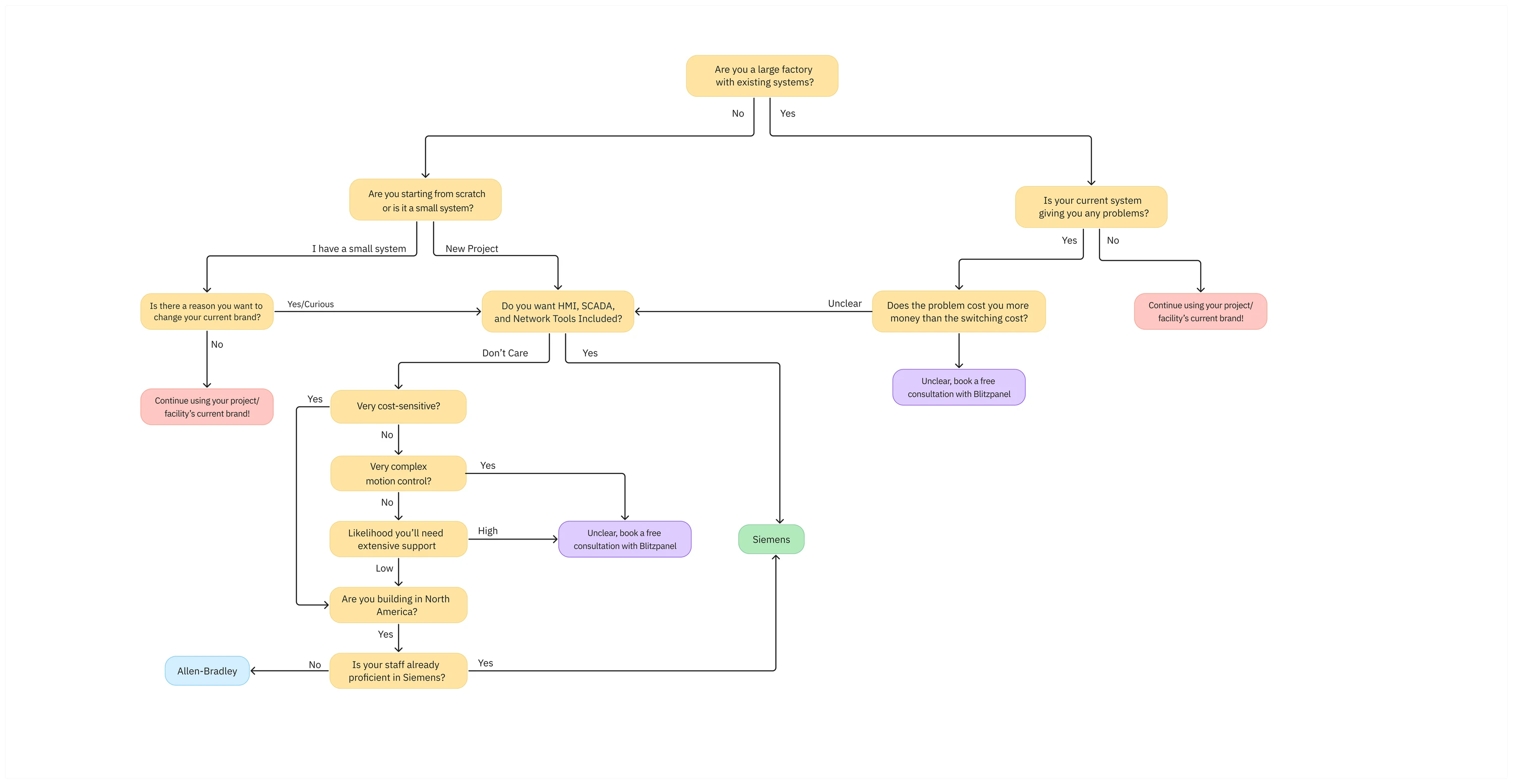
We made a flowchart to help you decide:
A few more things worth weighing:
- Single machine or whole plant?
- Process (power, water, chemical) or discrete (assembly, packaging)?
- Drives and motion heavy?
- Need PLC, screens, drives, and safety in one environment?
- What can your team already support?
- How fast do you need it running?
- Tight budget on a smaller system?
Work through these and the answer usually shows up on its own. And if it doesn't, that's exactly the kind of call Blitzpanel can help you make.
Conclusion
For anyone working in or around industrial controls long enough, the honest answer is that you end up knowing both. Most experienced controls engineers can read either platform's code, and most large facilities have at least some equipment in each ecosystem.
Either way, the goal isn't to get to the bottom of the Allen-Bradley vs. Siemens debate — it's to put the right platform in your panel and keep it running for the next 20 years.
If you're scoping a control panel project and want a straight read on which platform makes the most sense for your specific application, plant, and team, Blitzpanel is happy to walk through it. Contact us at [email protected] or tell us about your project here.
FAQ
What are some other brands of PLC?
Some other brands are Mitsubishi Electric and Omron (both Japanese, strong in Asia and on OEM machinery), Schneider Electric (French, big in Europe and process industries), and ABB (strong in heavy process and utilities). Mitsubishi and Omron in particular show up a lot on smaller, cost-sensitive machines, while Schneider and ABB tend to appear on larger process and infrastructure jobs.
Can I mix Allen-Bradley and Siemens in the same plant?
Yes, and lots of facilities do, usually because equipment came in from different builders or eras. They can be made to share data across the network with the right gateways or by using a common protocol both understand. It works, but it adds complexity: two software environments to maintain, two sets of spare parts to stock, and staff who ideally know both. That's why most facilities try to standardize even when they end up with some of each.
What is Blitzpanel?
Blitzpanel designs and builds custom electrical control panels. We work with engineers, OEMs, and integrators, providing expert engineering expertise and manufacturing support so panels are built right, documented properly, and delivered fast. Book a call with us here.
What are HMI development, drive development, and network design?
These are 3 other big jobs in a control system, and Siemens bundles them all into TIA Portal.
- HMI (Human-Machine Interface) development means building the operator UI — for example, designing the touchscreen a worker uses to start the line, watch tank levels, and see alarms. It's the human-facing window into what the PLC is doing.
- Drive development is configuring the variable frequency drives (VFDs) that control how fast motors spin. A drive takes a command from the PLC ("run the conveyor at 60%") and delivers the right power to the motor to make it happen.
- Network design is laying out how all these devices — the PLC, HMIs, drives, sensors, and other controllers — connect and communicate, including which protocols they use and how traffic is organized so everything talks reliably.
How long does a PLC last?
A well-maintained PLC commonly runs for 15 to 20 years or more.
Is one brand more reliable than the other?
In practice, both are highly reliable, and at this tier reliability is rarely the deciding factor. Failures more often trace back to installation, environment, or maintenance than to the brand on the cabinet. The more useful question is which platform your team can troubleshoot quickly when something does go wrong — which loops back to the article's main point about what your maintenance team already knows.
What is a protocol?
A protocol is just the agreed-upon language two devices use to talk to each other over a network.
Imagine a PLC wants to ask a temperature sensor: "what's your current reading?" The two devices agree ahead of time that every message will look like this:
[ WHO ] [ WHAT ] [ DETAIL ]
So the PLC sends:
[ 02 ] [ READ ] [ 7 ]
Which both sides have agreed means: "Device 02, READ register 7." The sensor, following the same rules, knows to reply in the agreed format:
[ 02 ] [ OK ] [ 75 ]
Meaning: "Device 02 here, OK, the value is 75." The PLC now knows the temperature is 75 degrees.
Which one is easier to learn if I'm new to PLCs?
Most newcomers find Allen-Bradley's Studio 5000 gentler to start with, largely because of its tag-based approach — naming data TankTemperature instead of tracking memory addresses. Siemens' TIA Portal is more powerful and configurable but less forgiving early on.
What are some common PLC terms to know to understand specs?
- Architecture: How the hardware physically goes together. Chassis means parts plug into a proprietary frame you must buy as a set; rail-mount means they clip onto a standard rail with off-the-shelf power.
- Max memory: How big a program the controller can hold; more memory means it can run larger, more complex logic.
- Modules per rack: How many add-on cards (inputs, outputs, comms) plug into the main frame before you need to expand.
- Processing speed: How fast it runs one instruction; faster means tighter timing for machines that react in fractions of a millisecond.
- Integrated motion: How well it coordinates multiple motors moving precisely and in sync, like a robotic arm or multi-axis machine.
- Entry price (CPU): Rough cost of just the controller's brain, before I/O cards, power, and software.
Resources
Build Your Control Panel
Start a project with Blitzpanel →