
What Is a Daughter Box? Control Panel Disconnect Safety Explained
7 min read · Last updated May 16, 2026
A daughter box is a separate enclosure that disconnects all power before it enters your control panel. Learn how it works, when to use one, and how it compares to a standard disconnect handle.
There's a lot of ways to kill yourself working on an industrial control panel. There's one great way to make sure you don't: a disconnect box. (We often call this a daughter box)
Here's The Problem
Level 1: No Local Disconnection
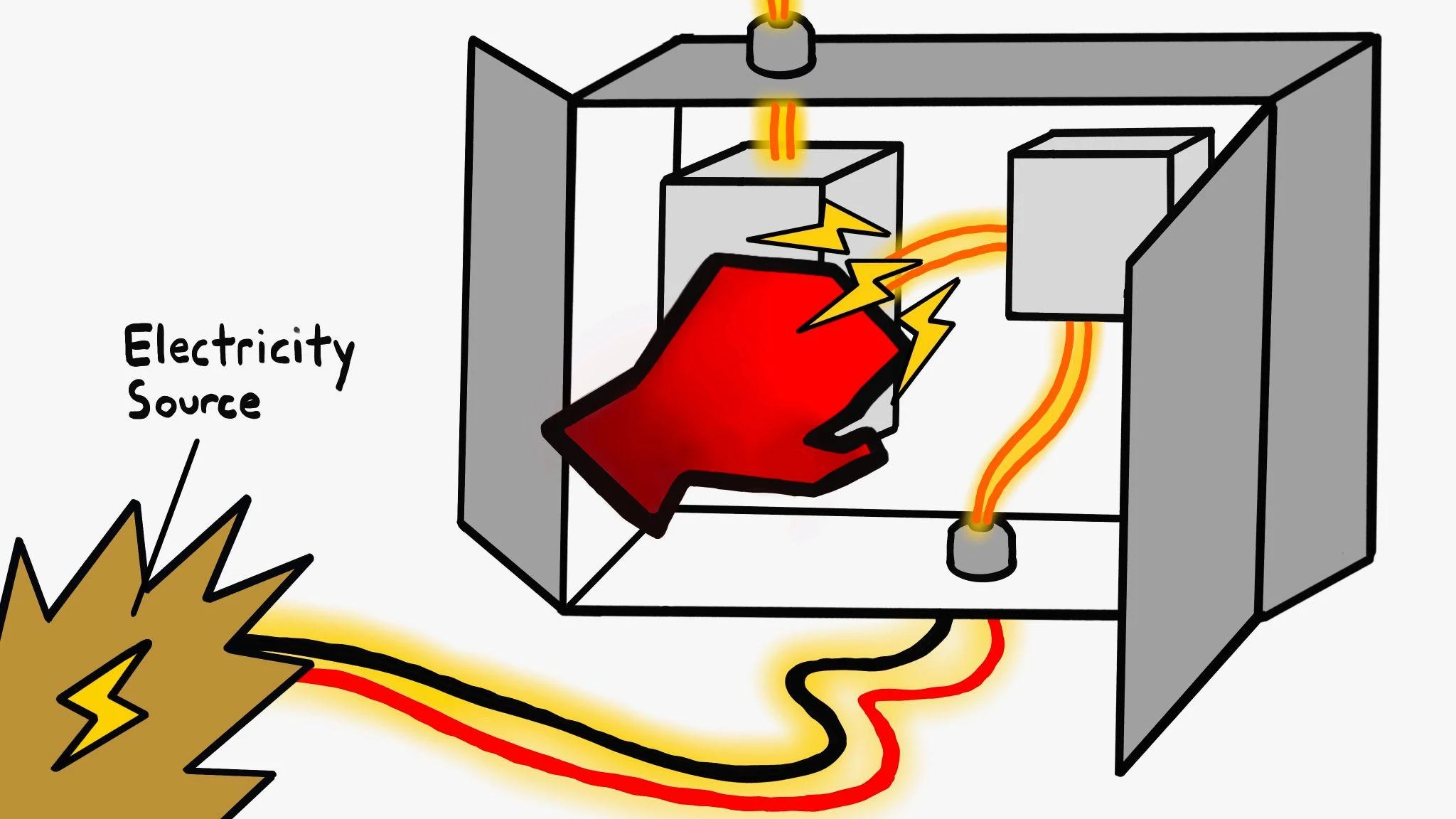
You can be easily electrocuted while servicing the panel since the wires inside are always live. You can try to be safer by disconnecting power at the source instead of at the panel, but this is less straightforward and annoying.
Level 2: Disconnect Handle

A disconnect handle kills power to the panel from the outside — but not before it enters the box.
Turn it OFF and the power inside the panel goes dead, so you can safely open the panel and service the equipment. The switch itself is inside the main enclosure connected to a handle on the outside through a shaft. This setup is called a through-shaft disconnect.
The tradeoff: the line side stays live. The wires feeding power into the switch remain energized even when the handle is OFF. So accidentally touching a wrong connection after a long shift could still lead to injury.
Level 3: Daughter Box
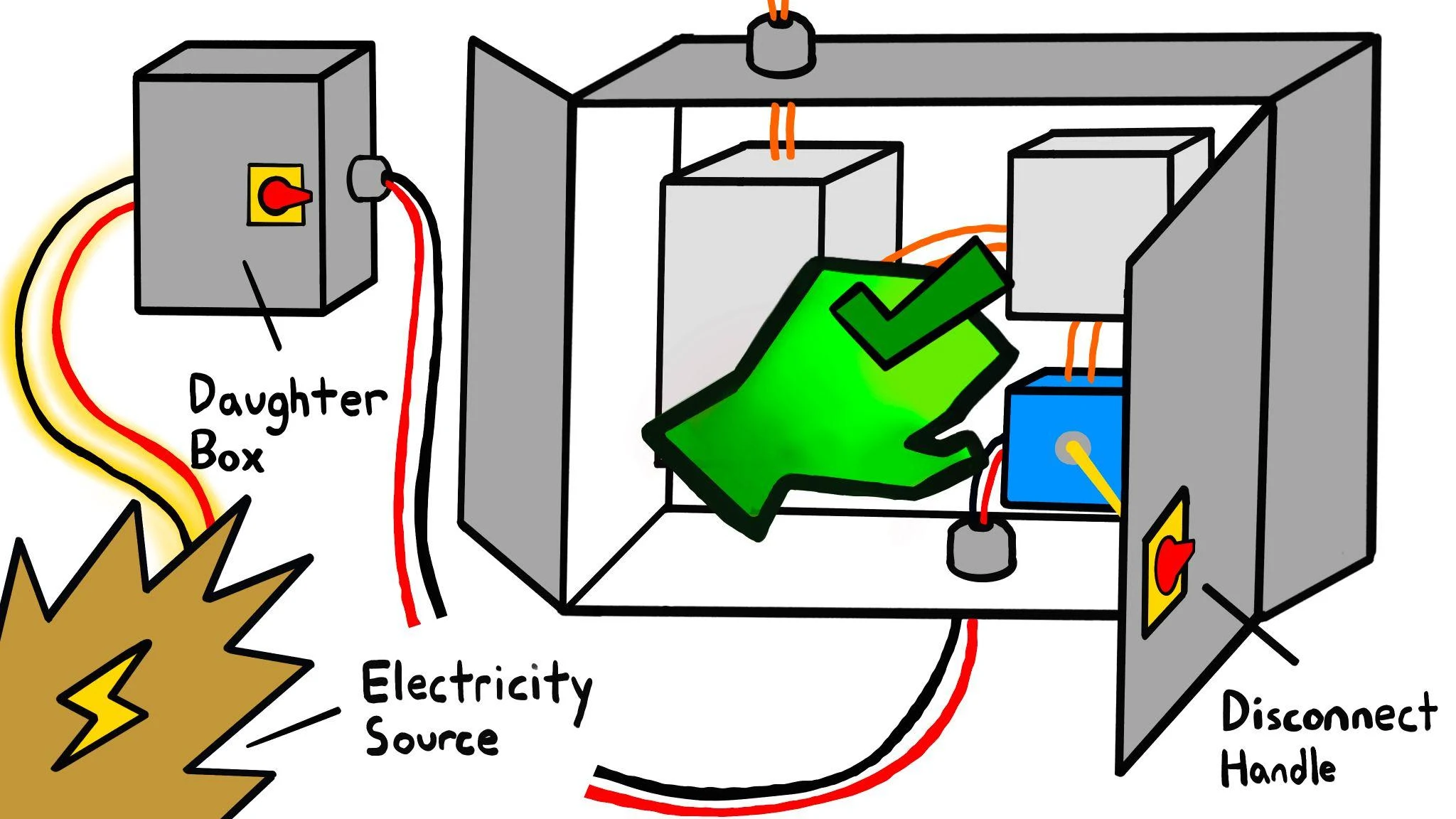
A daughter box adds a separate power switch, outside the main panel. As a result, you can turn off power a step earlier and ensure no live wires in the service area.
Instead of letting incoming power enter the panel directly, power passes through the daughter box first. When the daughter box is turned off, power is disconnected, and doesn't reach the main panel.
Since the panel is fully off and has no live wires anywhere, maintenance can be done without worry.
A Simple Solution
You probably already get it. At its core, a daughter box is home to a switch that lets you disconnect all power flowing into your electric control panel. While a typical disconnect handle allows wires to flow to the disconnect mechanism, a daughter box provides an added level of safety by making sure there are no live wires in the control panel whatsoever.
Breaking Down a Daughter Box
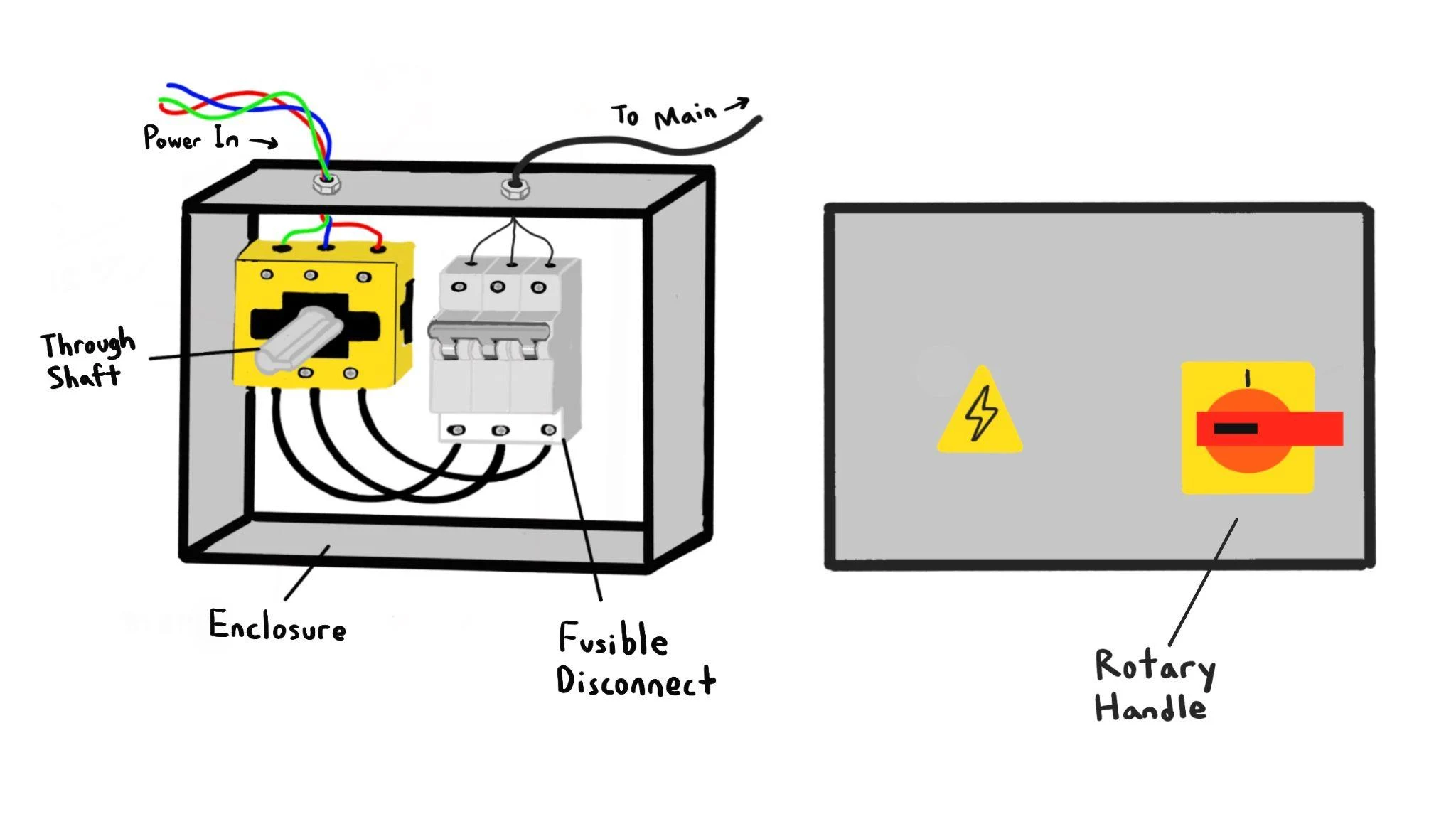
A daughter box looks simple from the outside — it's a metal box with a handle. It's fairly simple on the inside as well. Here's what each part does:
1. Live Side/Load Side and Cable Entries
The box has to handle two paths: power coming in and power going out.
The line side is where incoming power enters from, and the load side is where power leaves the switch and goes to the main control panel.
The wires enter and leave the enclosure through conduit entries/cable glands/knockouts. These openings need to be sized correctly and installed properly so the box still protects against the environment it was rated for.
2. Mounting the Enclosure
The enclosure protects components from the environment. It's rated by NEMA (in North America) or IP (international). The rating tells you what conditions the box can handle.
The next decision is how the box mounts. There are two common approaches:
Direct mounting makes lockout/tagout cleaner. Lockout/tagout (LOTO) is when the power switch is physically locked in the OFF position, through a padlock, so no one else can turn it on during service. No one can re-energize without cutting the lock.
Also, the rating only holds if every penetration — the openings — are sealed correctly.
3. The Disconnect Switch
The disconnect switch is the physical lever that breaks your circuit. There are different types to consider:
- Non-fusible: On/off only. Used when overcurrent protection exists upstream.
- Fusible: On/off plus integrated fuses for circuit protection.
- Circuit breaker: Combines shutoff with resettable overcurrent protection.
Note: when the switch is OFF, the line side still has power coming into the switch, but the load side feeding the main panel is cut off.
Once you know what type of switch you want, make sure it is rated for your system. Think about this:
- Is the panel being fed by 120 VAC, 240 VAC, 480 VAC, or something else?
- Is it single-phase or three-phase? A single-phase system will need a different switch than a three-phase system.
- How much current does the panel draw?
4. The Handle and Operating Shaft
The handle sits on the outside of the enclosure. The operating shaft is the rod that connects the handle to the switch. Turn the handle, the shaft rotates, the switch opens or closes.
A daughter box uses the same handle-and-shaft mechanism as a through-shaft disconnect.
Two handle styles cover most daughter boxes:
The Cost Of Safety
Whether a dedicated disconnect box is a worthwhile safety investment for your system is your decision. These are some levels of safety you can choose to achieve:
| Setup | Cost Profile | Maintenance Reality |
|---|---|---|
| Through-Shaft Disconnect | Lowest — adds one component to existing panel | The panel can be turned off, but there's still risk since line-side power is still live inside. |
| Partitioned Disconnect | Moderate — custom enclosure with internal isolation | The ON/OFF switch is inside a separate box inside the main panel, so there is still risk of injury. |
| Separate Disconnect Box | Higher — extra enclosure and integration work | Power is disconnected before it reaches the main panel; it's practically impossible for anyone's hands to get in a dangerous spot. |
A through-shaft disconnect, or a disconnect handle, is also relatively simple and cheap, because the disconnect is built into the main panel. A partitioned disconnect is a separate enclosure mounted into the main panel, so the switch lives in its own box inside the service area.
But the cheapest option is not always the safest option. During maintenance, the question is not just if the panel can be turned off. Rather, it's if the person opening it can immediately understand what is still dangerous.
A daughter box adds hardware, but it also removes ambiguity. Safety is not just about having the right equipment. It is about making the safe action obvious to the person standing in front of the box and minimizing the chance they might get hurt.
At Blitzpanel, we can help you choose the disconnect setup that fits your panel's safety needs, maintenance workflow, and budget.
Conclusion — How We Think About Daughter Boxes
A daughter box isn't complicated. It's a box, a switch, and a handle. But it's a smarter place to stop power. When the daughter box is OFF, the main panel has no live wires anywhere inside it. You can't touch what isn't there. It makes the panel easier to understand, easier to service, and safer to open.
At Blitzpanel, our controls engineers design panels around the people who actually have to use and service them. A daughter box is one of the simplest ways to make that experience safer from the start.
If you're building a panel that needs to be serviced safely, Blitzpanel can help you design the disconnect layout before it becomes an afterthought. Start a project with Blitzpanel →
FAQ
What is a daughter box?
A daughter box is a separate enclosure installed before the main control panel. It houses the disconnect switch so incoming power can be shut off before it enters the panel.
Why not just use a disconnect handle on the panel door?
A disconnect handle is useful, but the disconnect mechanism is usually inside the main panel. That means incoming line-side power may still be live inside the enclosure even when the handle is turned off. A daughter box moves that disconnect point outside the panel.
What type of switch goes inside a daughter box?
Common options include non-fusible disconnects, fusible disconnects, and circuit breaker disconnects. The right choice depends on the panel voltage, current, phase type, environment, and protection requirements.
Does the daughter box need a specific enclosure rating?
Yes. The enclosure should match the environment. A clean indoor area may need a basic indoor-rated enclosure, while outdoor, wet, dusty, oily, or washdown areas may need a higher NEMA or IP rating.
When is a daughter box worth considering?
A daughter box is worth considering when a panel is expected to be opened, serviced, modified, or inspected regularly. It's especially useful in environments or facilities where multiple technicians may service the same equipment.
What is NEMA? What is IP? How are they related?
NEMA (North American) and IP (international) are the two standards for rating enclosure protection against dust and water. They use different test methods, so the equivalents below are rough cross-references.
| NEMA Rating | IP Equivalent | Environment |
|---|---|---|
| NEMA 1 | IP10/IP20 | Indoor, general purpose |
| NEMA 2 | IP11/IP22 | Indoor, drips/splashing |
| NEMA 3 / 3S | IP54/IP55 | Outdoor, rain/dust/ice |
| NEMA 3R | IP14/IP24 | Outdoor, rain |
| NEMA 4 / 4X | IP65/IP66 | Indoor/outdoor, water/dust/corrosion |
| NEMA 6 / 6P | IP67/IP68 | Submersion |
| NEMA 12 / 13 | IP52/IP54 | Indoor, dust/falling liquid |
Resources
Build Your Control Panel
Start a project with Blitzpanel →