
How to Calculate SCCR for Your Control Panel
5 min read · Last updated June 12, 2026
What SCCR means, how to calculate it branch by branch, and how combination ratings and current-limiting fuses can raise it. A step-by-step walkthrough for panel builders.
Every control panel has a breaking point. Push it past its limit with a sudden fault current, and you're looking at melted components, ruined equipment, or worse. Preventing that disaster comes down to understanding one critical boundary: its Short Circuit Current Rating (SCCR).
SCCR is required on industrial control panels under UL 508A and is referenced by the NEC (NFPA 70) and OSHA. If your panel is going into a facility with high available fault current, which most industrial sites have, getting the SCCR right is not optional.
If you are specifying or building a panel and need SCCR calculated as part of the design, Blitzpanel handles this as part of every build. Reach out at [email protected].
What SCCR Actually Means
SCCR is the maximum short circuit current the panel as a whole can survive without causing a hazard. It is expressed in kA (kiloamperes) and applies to the entire assembly, not just individual components.
A panel is only as strong as its weakest component. A 100 kA-rated breaker paired with a contactor rated for 5 kA gives you a panel SCCR of 5 kA. Every component in the current path affects the final number.
How the Calculation Works: A Step-by-Step Walkthrough
To see this in action, let's calculate the SCCR for a control panel branch that runs a motor.
What You Need Before You Start
- The available fault current (AFC) at the panel's supply terminals, provided by the facility's electrical engineer or utility
- The datasheet for every current-carrying component in the panel: breakers, fuses, contactors, overloads, drives, soft starters
- Any listed combination ratings between components (more on this below)
Step 1: Identify Every Current-Carrying Component
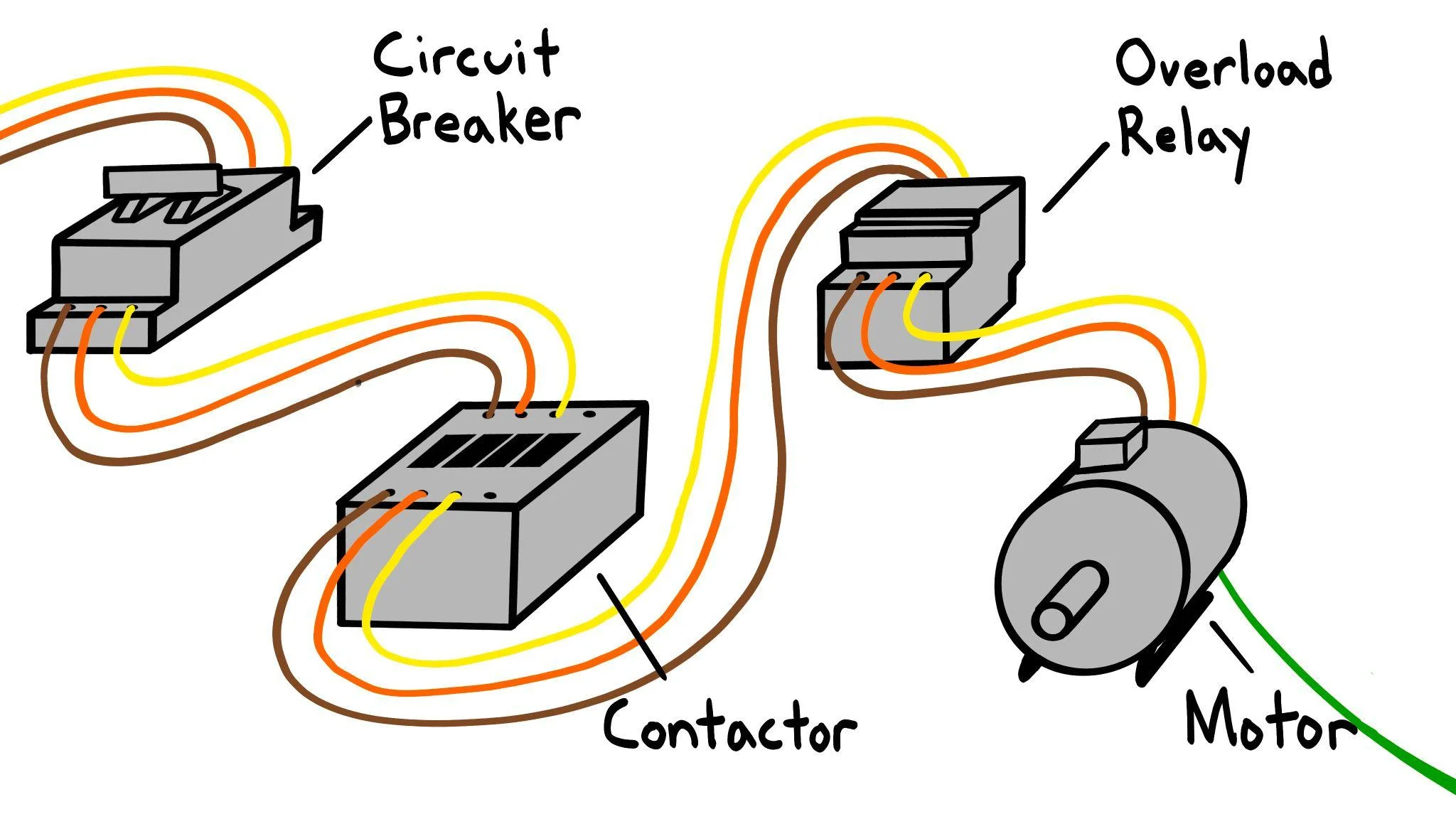
Work through the panel branch by branch. For each branch circuit, list every component in the current path from the incoming supply down to the load.
- Example: In our motor branch, the power flows through three main components: a Circuit Breaker, a Contactor (to turn the motor on/off), and an Overload Relay (to protect against overheating).
Step 2: Find the SCCR of Each Component
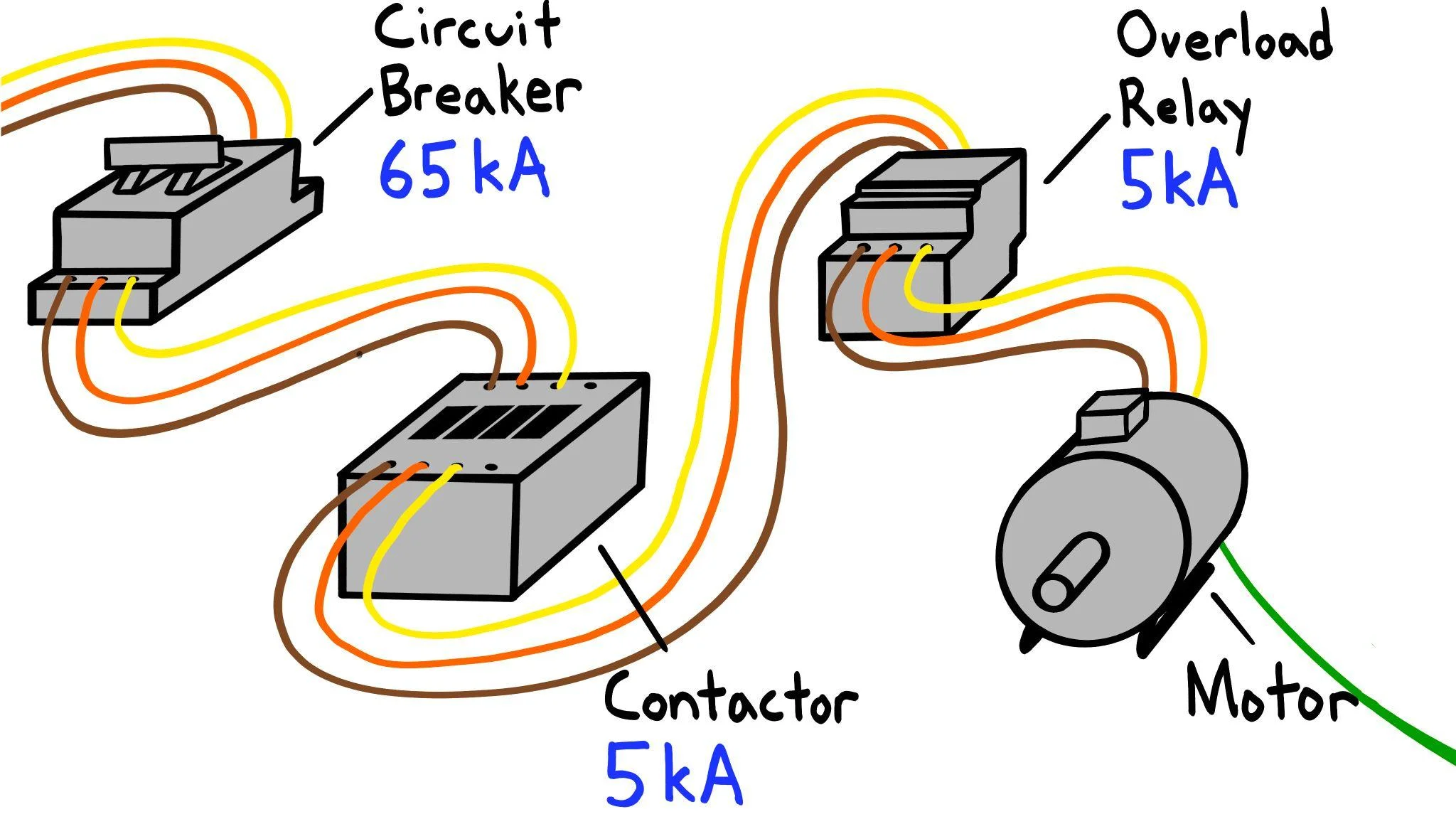
Check the datasheet or UL listing for each component to find its standalone short circuit rating. This is sometimes called the withstand rating or interrupting rating.
- Example: We look up our specific parts and find these standalone ratings:
- Circuit Breaker: 65 kA
- Contactor: 5 kA (standard default rating)
- Overload Relay: 5 kA (standard default rating)
Step 3: Apply Combination Ratings Where They Exist
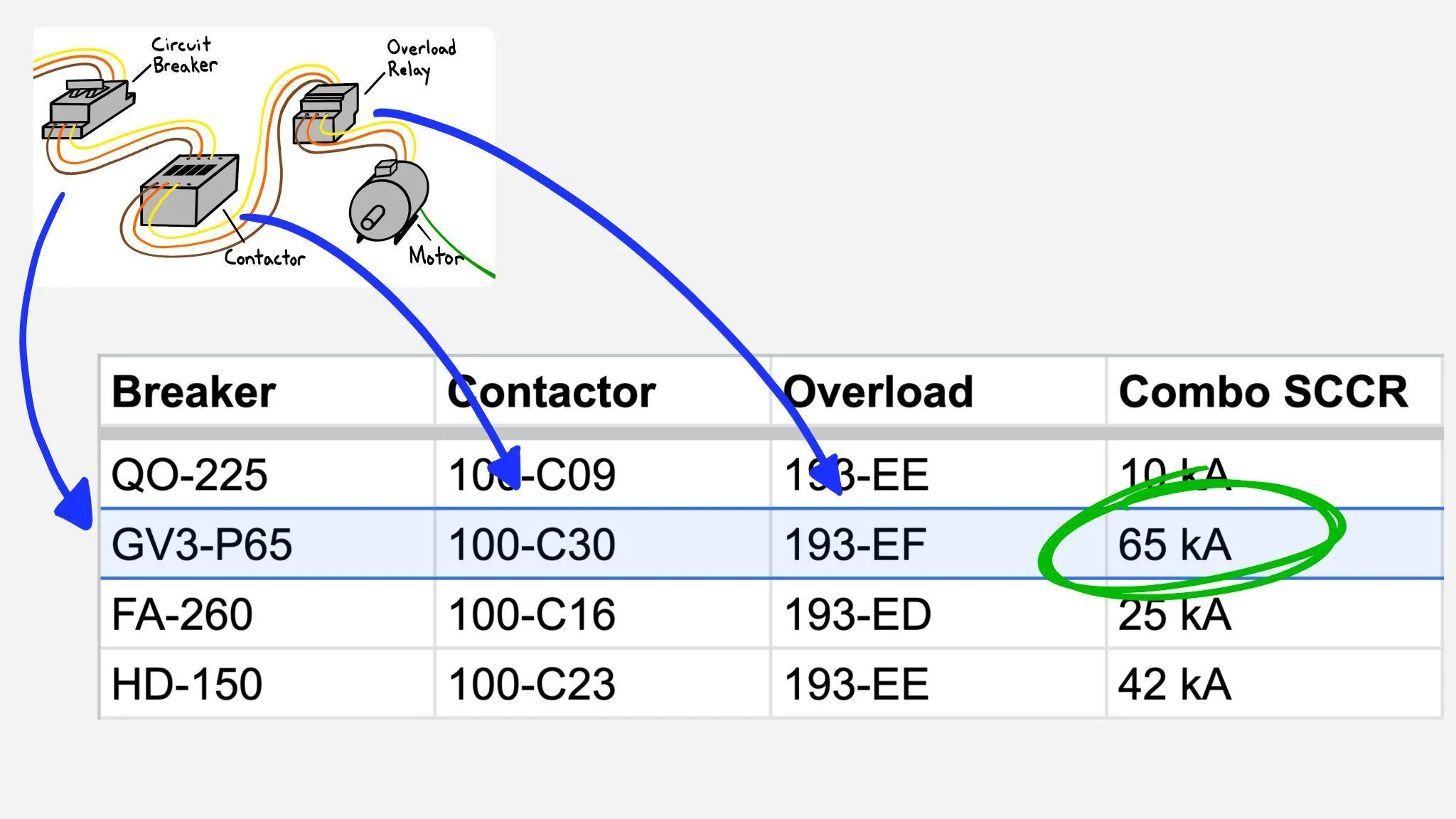
Component manufacturers frequently test and list their devices together. For example, a specific manufacturer circuit breaker paired with a specific contactor can often achieve a much higher combined SCCR than the devices could handle alone. If a listed combination rating exists in the manufacturer's literature, you can use that higher number.
- Example: We check the manufacturer's UL documentation. It turns out that when our specific Circuit Breaker is paired with this specific Contactor and Overload Relay, they are UL-approved as a tested combination rated for 65 kA.
Step 4: Determine the Branch SCCR
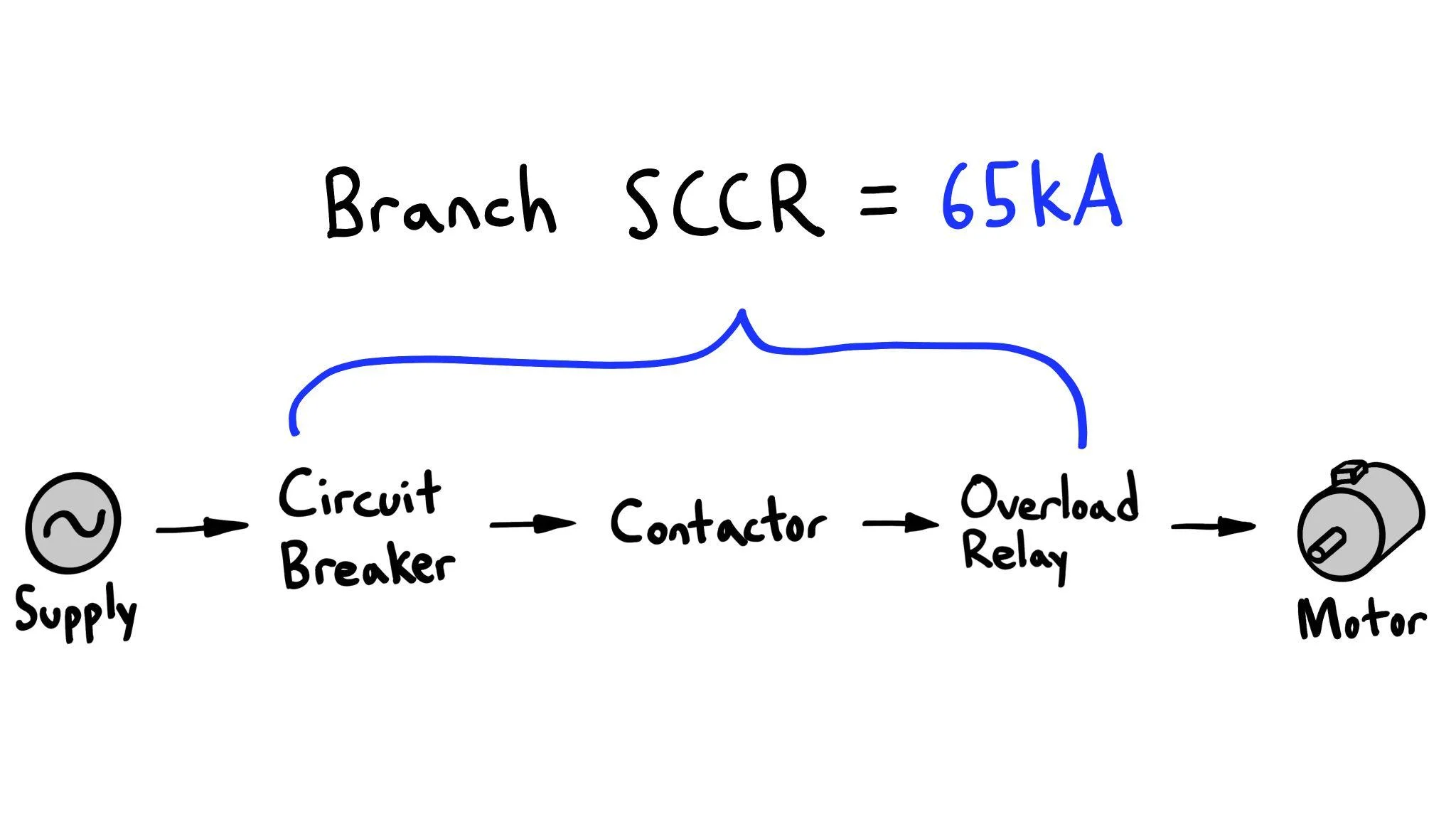
For each branch, the SCCR is the lowest rating among all components in that branch, unless a listed combination rating supersedes it.
- Example: Without the combination rating, our branch would be stuck at a weak 5 kA (the lowest individual component rating). But because our components form a verified manufacturer combination, the Branch SCCR is successfully elevated to 65 kA.
Step 5: Determine the Panel SCCR
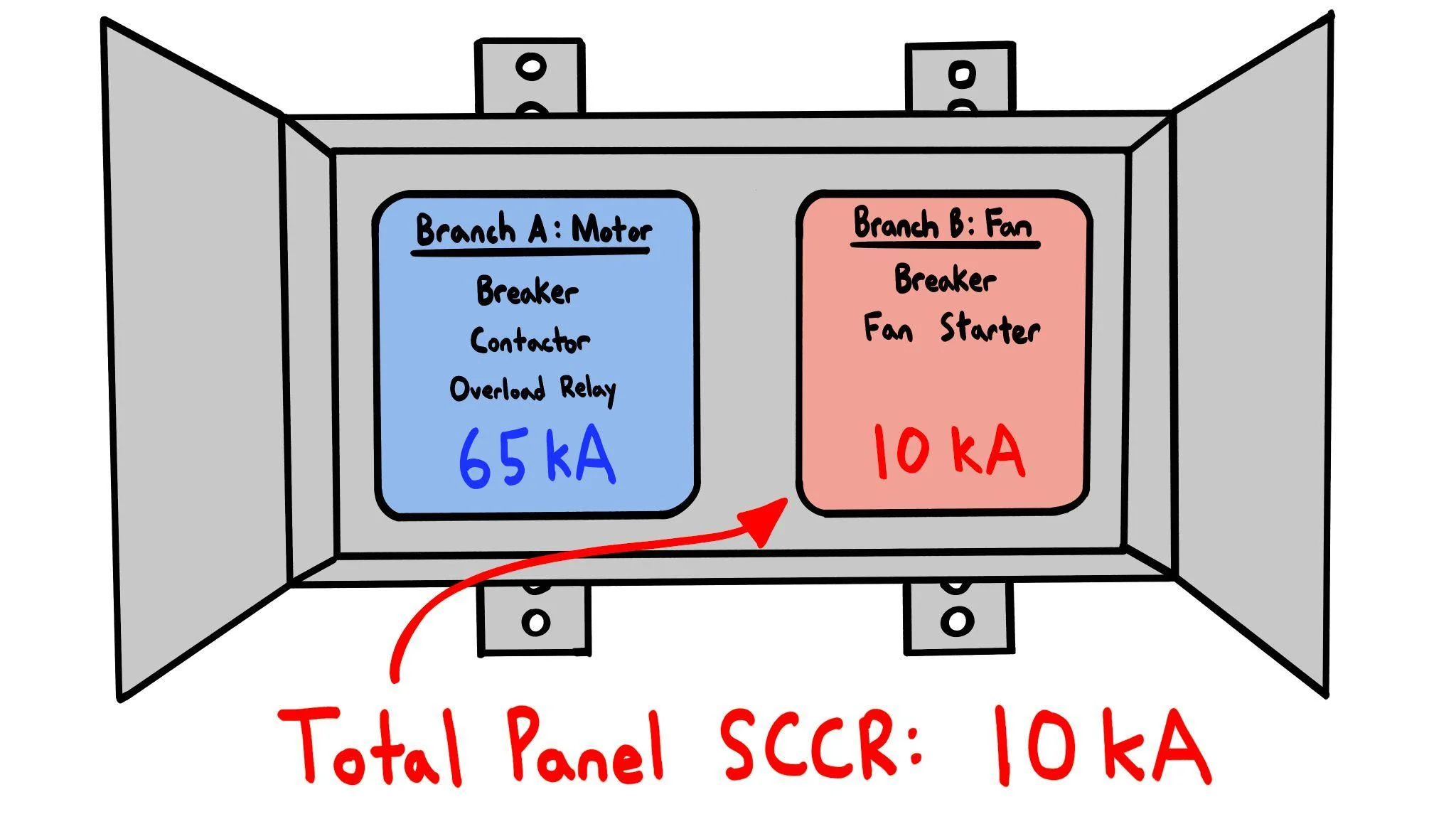
The overall panel SCCR is determined by the "weakest link": the lowest branch SCCR across the entire assembly.
- Example: Let's say our control panel has two branches:
- Branch A (Our Motor): 65 kA
- Branch B (A separate fan circuit): 10 kA
- Because Branch B has a lower rating, the overall Panel SCCR is 10 kA
Step 6: Compare Against Available Fault Current (AFC)
Finally, the panel SCCR must be equal to or greater than the Available Fault Current (AFC), the maximum amount of current the utility grid can push into the supply terminals during a short circuit.
- Example: The facility engineering team measures the power supply and determines the AFC at our installation site is 22 kA.
- Conclusion: Our panel is only rated for 10 kA. Because 10 kA is less than the 22 kA threat, the panel fails compliance and cannot be safely installed. To fix this, we would need to redesign Branch B using a combination rating or current-limiting fuses to push its rating above 22 kA.
The Fastest Way to Raise SCCR
Current-limiting fuses are the most common solution when a panel comes in below the required SCCR. A properly sized current-limiting fuse upstream of a branch can dramatically raise the effective SCCR of everything downstream, because it limits the let-through current before it reaches the weaker components. Many manufacturers publish fuse-based combination ratings specifically for this reason.
Common Mistakes
Skipping components. Every device in the current path counts. Terminal blocks with integrated fusing, disconnect switches, and power supplies all have SCCR ratings and all need to be checked.
Ignoring combination ratings. Building a panel without checking for listed combination ratings leaves performance on the table. A pair of components that individually rate at 5 kA might achieve 65 kA as a listed combination.
Confusing interrupting rating with SCCR. A breaker's interrupting rating is how much current it can interrupt and survive. That is not the same as the panel's SCCR, which accounts for all downstream components too.
Not getting the AFC from the facility. The available fault current varies by site and by where in the distribution system your panel connects. Do not assume—get the number from the electrical engineer or utility before finalizing the design.
Conclusion
SCCR is one of those ratings that is easy to overlook during panel design and expensive to fix after the fact. The calculation itself is straightforward: find the weakest link in each branch, find the weakest branch in the panel, compare it to available fault current. The work is in the component research and in knowing where listed combination ratings can lift the number without a full redesign.
Blitzpanel builds UL 508A compliant control panels so you won't have to worry about SCCR yourself. We'd love to get you a quote for your project.
FAQ
What is the minimum SCCR required?
The NEC requires the panel SCCR to equal or exceed the available fault current at the installation point. There is no universal minimum, it depends entirely on the facility.
What is Blitzpanel?
Blitzpanel designs and builds custom electrical control panels. We work with engineers, OEMs, and integrators, providing expert engineering expertise and manufacturing support so panels are built right, documented properly, and delivered fast. Book a call with us here.
Where do I find available fault current?
From the facility's electrical engineer, the utility, or a short circuit study of the distribution system. It varies by site and by connection point within the site.
What is a listed combination rating?
A tested and published rating for two or more specific components used together, which may be higher than the individual ratings of those components alone. Check manufacturer documentation for the specific part numbers you are using.
Does SCCR apply to every panel?
UL 508A requires SCCR marking on industrial control panels. If the panel is being installed in a facility subject to NEC requirements, which covers most commercial and industrial installations in the US, it applies.
Can I use a single large fuse to raise the whole panel's SCCR?
A current-limiting fuse at the panel's incoming supply can raise the effective SCCR of downstream components, but only when the manufacturer has published a listed combination rating for that configuration. You cannot simply add a fuse and assume the rating improves without a listed basis for that claim.