Structured Text vs Ladder Logic: When to Use Each
13 min read · Last updated June 18, 2026
How the two main PLC programming languages differ, why ladder is still everywhere, when structured text wins, and how to choose for your control panel.
Most people think of a control panel as a box full of wires, breakers, buttons, and terminals.
But the real decision-making usually happens inside the PLC.
The PLC is the device in your panel that decides things like:
- When a motor should turn on
- When a pump should shut off
- When a fault should stop the machine
- When a sensor should trigger the next step
To make those decisions, someone has to program the PLC.
Two of the most common ways to do that are Ladder Logic and Structured Text.
They can both control the same machine. They just do it in very different ways.
What Are Ladder Logic and Structured Text?
Ladder Logic and Structured Text are two common ways to tell a PLC what to do. They can control the same machine, but one looks like an electrical diagram and the other looks more like code.
Ladder Logic
Ladder Logic is a way to program a PLC using symbols that look like an electrical drawing.
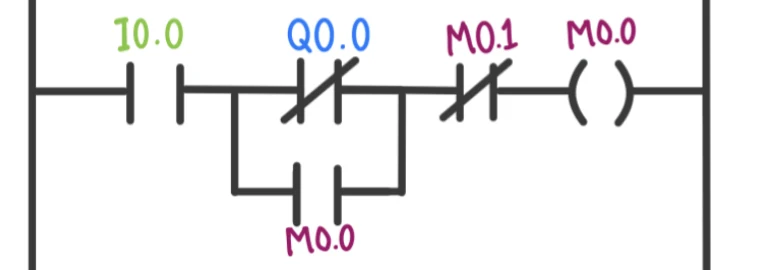
If the button is pressed
AND
either the output is currently off OR M0.0 is already on
AND
M0.1 is NOT on
then the PLC sets M0.0 to on.
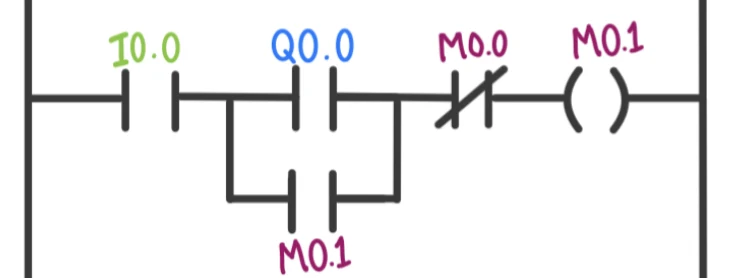
If the button is pressed
AND
either the output is currently on OR M0.1 is already on
AND
M0.0 is NOT on
then set M0.1 to on.
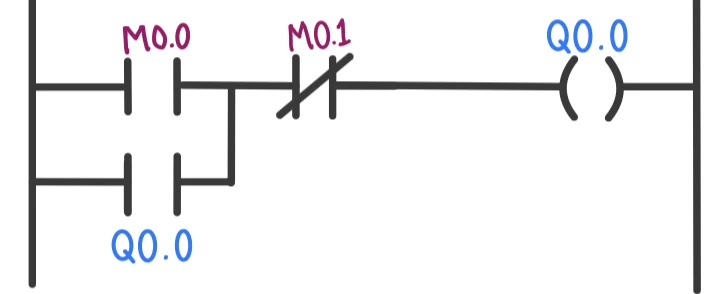
If M0.0 is on OR the output is already on
AND
M0.1 is NOT on
then turn on the output.
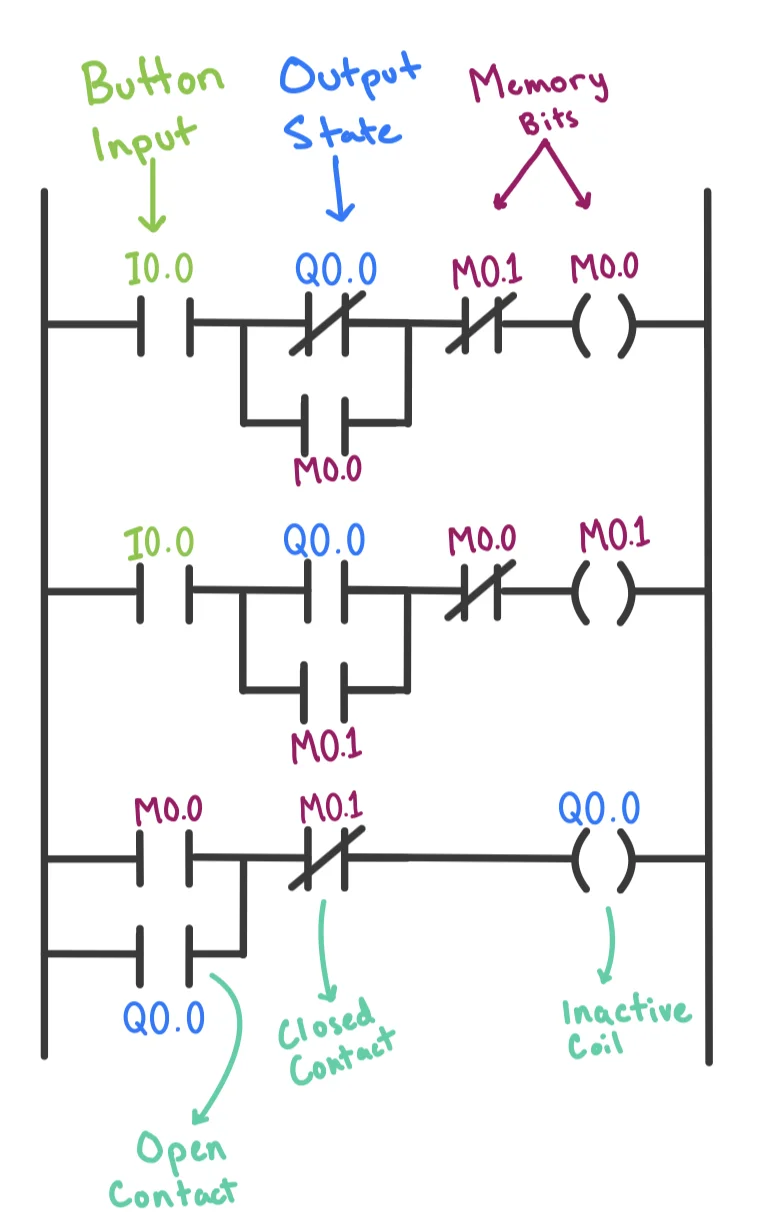
Ladder Logic from PLC Academy annotated by Blitzpanel.
Here is a simple On/Off button latch built with Ladder Logic.
It was built for people who understood relays, switches, contacts, coils, and control wiring.
That is why it looks like a ladder:
- Two vertical rails on the sides
- Horizontal lines called rungs
- Conditions on the rung
- An output at the end
A simple rung might mean: If the start button is pressed, and the stop button is not pressed, turn on the motor.
That makes Ladder Logic easy to follow for many electricians and maintenance techs.
They can open the PLC program and see which condition is stopping a motor, valve, light, alarm, or other output from turning on.
Structured Text
Structured Text is also a way to program a PLC. The difference is that Structured Text looks more like normal code.
Instead of drawing the logic with contacts and coils, you write it with words and statements.
The same On/Off button example, but in Structured Text:
    IF StartButton AND NOT StopButton AND
    EStopOK THEN
        MotorRun := TRUE;
    ELSE
        MotorRun := FALSE;
    END_IF;
Which means:
If the start button is on and the stop button is not on, run the motor. Otherwise, keep the motor off.
Structured Text is useful when the logic becomes too long, repetitive, or complicated to draw neatly in Ladder.
It is often better for:
- Math
- Repeated logic
- Recipes
- Arrays
- Loops
- Data handling
- More complicated machine decisions
The Simple Difference
The simplest way to compare them is this:
Ladder Logic looks like a control circuit.
Structured Text looks like code.
Ladder Logic is usually easier to watch and troubleshoot.
Structured Text is usually easier to write when the logic gets complicated.
Neither one is automatically better.
They are just better for different jobs.
If you're trying to decide between the two, consider calling us here. Blitzpanel designs control panels with the maintenance team in mind, so the wiring, documentation, and PLC structure are easier to support later. We're happy to talk about your project!
Why Ladder Logic Is Still So Common
Ladder Logic is still common because factories need machines that can be fixed quickly.
When a machine stops, the person looking at the PLC program might not be the original programmer.
It might be a maintenance tech standing in front of the panel trying to answer one question: Why is this output not turning on?
Ladder Logic is good for that.
It makes simple machine logic very visible.
You can often see:
- Which sensor is off
- Which safety condition is missing
- Which fault is active
- Which permissive is blocking the machine
- Which output is being commanded
That is why Ladder Logic is still used heavily for basic machine control.
Why Structured Text Is Becoming More Important
Modern machines are doing more than simple start and stop logic.
They may have:
- More sensors
- More data
- More recipes
- More communication between devices
- More advanced HMIs
- More calculations
- More repeated machine sections
That kind of logic can get messy in Ladder.
Structured Text lets the programmer write the same idea in fewer lines.
For example, if a machine has 30 zones, Structured Text can loop through all 30 zones instead of drawing the same logic 30 times.
That does not mean Structured Text is always better.
It just means it can be cleaner when the program starts acting more like software.
Is There One Official Version of Ladder Logic or Structured Text?
Ladder Logic and Structured Text are part of a larger PLC programming standard called IEC 61131-3. They are not owned by one PLC company.
The standard defines the basic rules for common PLC programming languages, including:
- Ladder Diagram, often called Ladder Logic
- Structured Text
- Function Block Diagram
- Sequential Function Chart
But each PLC brand still handles them a little differently.
Siemens, Allen-Bradley, Beckhoff, and CODESYS-based PLCs may all support Ladder Logic or Structured Text. But each platform has its own programming software, compiler, libraries, and small syntax differences.
That means PLC code isn't copy-and-paste portable from one brand to another.
So there is a common standard, but there is not one universal Ladder Logic editor or one universal Structured Text compiler.
Choosing the PLC language is only one part of the design. The platform, documentation, I/O layout, and support plan all matter too. If you want a control panel that is easier to build, program, and maintain, Blitzpanel can help you plan it from the start.
Pros and Cons of Ladder Logic and Structured Text
Ladder Logic is strongest when the machine logic needs to be easy to see. It works well for start/stop circuits, motor commands, pump commands, alarms, interlocks, manual mode, and troubleshooting.
Its main downside is that it can get messy when the logic becomes repetitive, math-heavy, or data-heavy.
Structured Text is strongest when the logic is easier to write as code. It works well for calculations, recipes, loops, arrays, data handling, communication logic, and repeated machine sections.
Its main downside is that it can be harder for maintenance teams to read if they are used to electrical drawings.
| Ladder Logic | Structured Text | |
|---|---|---|
| Best for | Simple, visible machine control | Repeated, math-heavy, or code-like logic |
| Pros | Easy to watch while troubleshooting Familiar to many electricians and maintenance techs Good for start/stop, interlocks, alarms, and outputs | Cleaner for loops, arrays, calculations, and recipes Can reduce repeated rungs Feels more natural for software-style logic |
| Cons | Can get messy when the logic gets large or repetitive Not ideal for heavy math or data handling | Can be harder for non-programmers to follow Less visual when troubleshooting a machine on the floor |
| Examples | Motor starts, pump commands, alarm logic, permissives, manual mode, sensor-to-output logic | Recipes, data handling, repeated machine sections, calculations, sorting/comparing values |
| General Use Case | Use it when someone needs to quickly see why something is not turning on | Use it when the application is logic-heavy |
The simple tradeoff:
Ladder Logic is usually easier to troubleshoot.
Structured Text is usually easier to organize when the logic gets complicated.
How to Choose Between Them
The best question isn't "Which language is better?", rather "Who has to understand this later?"
If the plant maintenance team mostly understands Ladder, writing everything in Structured Text can make the machine harder to support.
If the machine has lots of repeated calculations, writing everything in Ladder can make the program harder to maintain.
The right choice depends on:
- The machine
- The customer
- The maintenance team
- The PLC platform
- The type of logic being written
- How often the system will need to be changed later
This should not be treated like a fight between old and new.
A lot of real PLC programs use both.
For example:
- Ladder Logic for motor control, interlocks, alarms, and troubleshooting
- Structured Text for calculations, loops, recipes, and repeated logic
There is some data showing the split. In older Control Engineering research, Ladder Logic was used far more than any other PLC language, while Structured Text was much lower but growing. By 2020, Structured Text had increased in their controller programming research.
That doesn't mean Ladder Logic is disappearing, just that PLC programs are changing.
Ladder is still the common language for simple machine control and troubleshooting. Structured Text is becoming more useful as machines need more calculations, data handling, and repeated logic.
We can help decide what belongs in Ladder, what belongs in Structured Text, and how to document it clearly for the people who have to maintain it. Book a call with Blitzpanel here.
Conclusion
Ladder Logic and Structured Text are both ways to tell a PLC what to do.
Ladder Logic is visual. It looks like a control circuit. That makes it useful for simple machine logic and troubleshooting.
Structured Text is written like code. That makes it useful for calculations, repeated logic, recipes, and more complicated machine behavior.
The best control systems do not pick one just because it sounds newer or more advanced.
They use the language that makes the machine easier to understand, easier to fix, and easier to maintain.
We looked through a variety of articles and resources in researching this article. Ladder logic and structured text are complex subjects. If you’re interested in learning more, click here to receive our compiled list of additional resources.
FAQ
What is Blitzpanel?
Blitzpanel designs and builds custom electrical control panels. We work with engineers, OEMs, and integrators, providing expert engineering expertise and manufacturing support so panels are built right, documented properly, and delivered fast. Book a call with us here.
Is Ladder Logic better than Structured Text?
Not always.
Ladder Logic is usually better when the logic needs to be easy to see and troubleshoot.
Structured Text is usually better when the logic is repetitive, math-heavy, or hard to draw neatly.
The better choice depends on what the machine is doing and who has to maintain it later.
Is Structured Text a real coding language?
Yes.
Structured Text is a programming language for PLCs.
It looks more like normal code than Ladder Logic does. Instead of drawing contacts and coils, you write statements like IF, THEN, ELSE, and END_IF.
Is Ladder Logic going away?
No.
Ladder Logic is still very common because it is easy for maintenance teams to troubleshoot.
Structured Text is becoming more useful as machines get more complex, but that does not mean Ladder Logic is disappearing.
In many systems, both are used.
Can one PLC program use both Ladder Logic and Structured Text?
Yes.
Many PLC platforms let programmers use more than one language in the same project.
For example, a system might use Ladder Logic for motor commands and alarms, then use Structured Text for calculations, recipes, or repeated logic.
Why not write everything in Structured Text?
Because the person fixing the machine may not be a software programmer.
If a maintenance tech needs to quickly see why a motor will not start, Ladder Logic may be easier to follow.
Structured Text can be cleaner for complex logic, but it can also be harder to troubleshoot for someone who is not used to reading code.
Why not write everything in Ladder Logic?
Because some logic gets messy when it is drawn out rung by rung.
If the program needs loops, arrays, calculations, or repeated logic, Structured Text can be much cleaner.
A task that takes dozens of ladder rungs might only take a few lines of Structured Text.
Are Ladder Logic and Structured Text the same across every PLC brand?
Not exactly.
They are both part of the IEC 61131-3 PLC programming standard.
But each PLC brand still has its own software, compiler, libraries, and small syntax differences.
So a program written for one PLC platform may not copy directly into another one.
Which one should a beginner learn first?
Most beginners should start with Ladder Logic.
It teaches the basic PLC ideas clearly:
- Inputs
- Outputs
- Contacts
- Coils
- Timers
- Counters
- Interlocks
After that, Structured Text is easier to understand because you already know what the PLC is trying to control.
Do I need to buy a PLC to learn these?
No.
There are free simulators and software tools that let you practice without buying hardware.
That is usually the best way to start.
Build simple examples first, like pressing a button to turn on a light. Then add a stop button, timer, fault condition, and sequence.
What is the simplest way to remember the difference?
Ladder Logic looks like a control circuit.
Structured Text looks like code.
Ladder is easier to see.
Structured Text is easier to write when the logic gets complicated.