The Eccentric Father of the PLC: Dick Morley
7 min read · Last updated July 8, 2026
The story of Dick Morley, the ski-obsessed MIT dropout who sketched the first programmable logic controller during a New Year's hangover in 1968 and changed factory automation forever.
Every PLC humming away in a control panel today traces back to a guy who invented it because he had a hangover, dropped out of MIT because he didn't want to learn German, and once quit a stable engineering job because his boss wouldn't let him ski on weekdays.
That guy is Richard "Dick" Morley. He never liked being called the inventor of the programmable logic controller. He preferred "father," because, as he put it, the PLC invented itself once the need showed up. But father or inventor, Morley is the reason a "box of software in cast iron" replaced fifty feet of relay cabinets, and the reason almost every factory on earth runs on logic he scribbled down on New Year's Day, 1968.
As a modern control panel factory, Blitzpanel has Dick to thank for the PLCs in all of our electrical boxes. Contact us here if you need a control panel for your factory.
Who Was Dick Morley?

Richard E. Morley was born December 1, 1932, in Clinton, Massachusetts, and grew up on a farm before the family moved in and around New York City. He studied physics at MIT, though after attending for about four years, he dropped out. The degree required a foreign language, and Morley had no interest in learning German.
By the mid-1960s, he was working a desk job designing airplanes, radar systems, and communications equipment for the kind of company where nobody ever visited the engineer in the corner office. He was good at it. He was also, by his own account, bored out of his mind.
The Invention That Started With a Ski Trip
A friend named Jonas Landau looked at Morley's life, said he needed to get out more, and took him skiing for the first time. Morley loved it. The problem was that everyone else loved skiing too, so the slopes were packed on weekends. Morley asked his employer if he could swap his schedule, working Saturdays and skiing on Fridays instead. The answer was no, it was against company policy.
So Morley quit. Not to start a revolution in industrial automation. Just to ski on weekdays.
With a new baby, a mortgage, and about $1,000 in the bank, he and a friend named George Schwenk started a consulting firm called Bedford Associates, named for its location in Bedford, Massachusetts. The company helped local machine-tool shops modernize their equipment, project after project, each one looking a little too much like the last.
Predictably, Morley got bored again. If every project needed roughly the same kind of controller, why not build one controller flexible enough to handle them all?
The Hangover That Built the Modicon 084
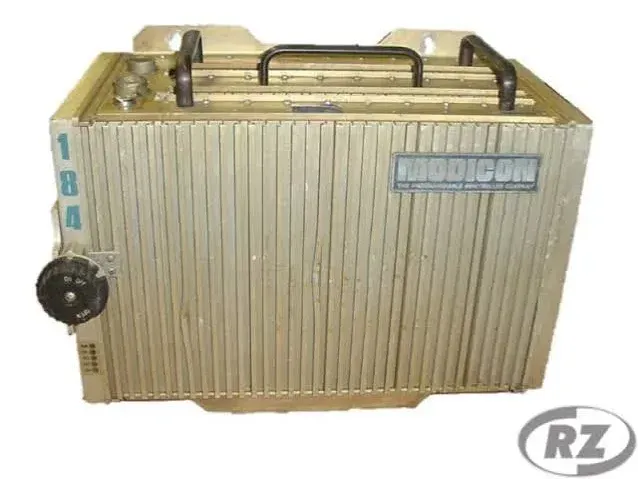
On January 1, 1968, Morley was nursing a New Year's hangover and staring down a proposal that was already two weeks late. Instead of finishing the proposal, he sat down and wrote out, in one sitting, the complete concept for a programmable controller: a rugged, modular device with no interrupts, direct memory mapping, and a language built for technicians rather than computer scientists.
He brought the memo to his Bedford colleagues, including Mike Greenberg, Jonas Landau, and Tom Boissevain. Together they built the unit and called it the 084, simply because it was the 84th project Bedford had taken on. The team had one hard rule during development: nobody was allowed to call it a computer. Plant managers in 1968 wanted nothing to do with computers.
The hardware itself was unusual for its time. It vented heat through metal fins instead of needing a sealed, air-conditioned cabinet, and it was built to survive the kind of physical abuse a factory floor dishes out daily. A new company called Modicon, short for MOdular DIgital CONtroller, was incorporated to bring it to market.
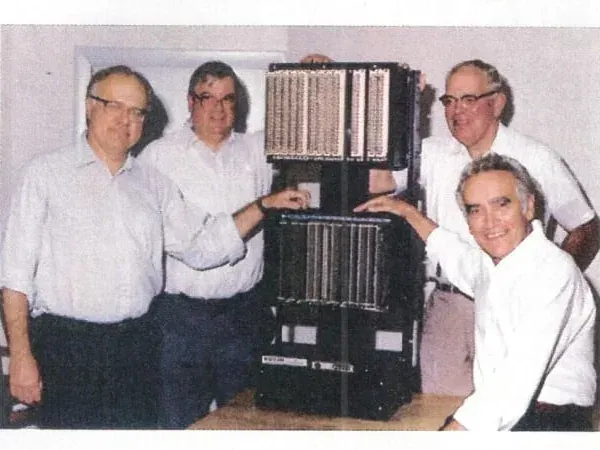
What the Modicon team didn't know was that an engineer at GM Hydramatic had already gone looking for exactly this kind of solid-state replacement for relay panels. GM ended up placing roughly a million dollars in orders, and Modicon was suddenly a real business. General Electric followed with another million dollars in orders shortly after. The PLC era had begun, mostly by accident.
A Hundred and Ten Companies and Counting
Modicon eventually outgrew Bedford Associates, which dissolved for tax reasons, and Modicon itself was sold first to Gould Electronics and later to Schneider Electric, which still sells PLCs under the Modicon name today. Morley, never an official employee on Modicon's payroll despite running its engineering, simply moved on to the next thing.

And the next thing. And the next. Over his career he helped found more than 100 companies, including Andover Controls, and held over twenty patents covering everything from the floppy disk and the handheld terminal to anti-lock brakes, personal rapid transit systems, and an early parallel inference machine. He was inducted into the Automation Hall of Fame, won the Franklin Institute's Howard N. Potts Award, and was named Entrepreneur of the Year by Inc. Magazine. None of it seemed to interest him much; people who worked with him said he was happiest chasing the next unsolved problem, not collecting plaques for the last one.
Life on a 90-Acre Stagecoach Stop
Morley's personal life was as unconventional as his career. He met his wife, Shirley, at a bar, where she was busy arm-wrestling men and winning. He decided on the spot that she was the one. They were married for 56 years.
The couple settled on a 90-acre property in a sparsely populated part of New Hampshire, once a stagecoach stop, where Morley valued privacy enough to convert an old barn on the land into his personal office rather than work in the main house. He called the original house "Shirley's house" because he was rarely in it. When the area's internet access wasn't good enough for his liking, he simply built his own internet tower and let neighbors connect to it for a small monthly fee.


Beyond the two children he and Shirley raised biologically, the couple took in roughly 40 foster children over the years, most of them teenagers from troubled homes. It started when their daughter brought home a friend who needed somewhere safe to live. Word spread, and the Morleys kept saying yes. In court, they insisted on one condition: they would not accept payment for fostering, so each child would know they were wanted, not subsidized.
Morley described himself bluntly: balding, overweight, dyslexic, a self-described hermit and workaholic with "a good sense of humor." The dyslexia kept him from writing seriously for most of his career, something he later called his biggest regret, until voice-recognition software let him finally put his ideas on paper. He rode Harleys, wrote for technical publications and science fiction alike, and reportedly kept working ten-hour days, six days a week, well into his 80s, taking Saturdays off only to catch a movie.
He died on October 17, 2017, in New Hampshire, at age 84.
Why "Father" and Not "Inventor"
Morley resisted the word "inventor" for the rest of his life, and not out of false modesty. He pointed out that the GM engineer who triggered the original request for proposals had no idea Bedford and Modicon already had a working unit, and that dozens of engineers across the industry were independently bumping into the same problem at the same time. "It really just grew by itself," he said decades later. "You put the seed in, and the venture capitalist materialized, and God, the marketplace, rained on it, and son of a gun, there it is."
That framing matters more than it might seem. The PLC wasn't a single flash of genius locked in one mind. It was an idea whose time had come, caught by a restless, hungover engineer who happened to be in the right hallway. Which may be the most fitting legacy of all for the man who replaced fifty feet of relay logic with a box that fit in one hand.
Morley scribbled the 084 onto paper because he was tired of building a slightly different control system for every job that landed on his desk. Almost 60 years later, that same problem still shows up in every plant that needs a panel built right and built fast. That's the gap Blitzpanel fills: full design-build for UL-certified control panels, so the logic an engineer writes ends up in a panel that's wired, documented, and ready to run, without the wait. Start a project with Blitzpanel.
FAQ
What is Blitzpanel?
Blitzpanel designs and builds UL-certified industrial control panels. Our model is built for speed and clarity: transparent pricing up front, fast turnaround, and no shop handoff, so the panel you spec is the panel that gets built and shipped. Book a call with us here.
What was the first PLC Dick Morley created?
The Modicon 084, built in 1968 for General Motors. The name came from the fact that it was Bedford Associates' 84th project, not from any technical specification.
Why is Dick Morley called the "father" of the PLC instead of the inventor?
Morley believed the PLC was an idea whose time had come industry-wide, developed by a team rather than a single person, and arrived at independently by other engineers around the same time. He used "father" to credit the collective effort behind it.
Did Dick Morley work on anything besides the PLC?
Yes. He held more than 20 patents covering things like the floppy disk, handheld terminals, anti-lock brakes, and personal rapid transit systems, and he founded or co-founded more than 100 companies over his career.
Where did Dick Morley live?
For over 40 years, he lived on a 90-acre former stagecoach stop in a remote part of New Hampshire, where he worked out of a converted barn on the property.
Glossary
PLC (Programmable Logic Controller). The industrial computer that runs control logic for machines and processes. Morley and the Bedford/Modicon team built the first commercially successful one.
Modicon 084. The original 1968 programmable controller built for General Motors, named for being Bedford Associates' 84th project.
Relay logic / "click-clack logic." The electromechanical relay panels PLCs replaced, named for the sound the relays made while running.
Ladder logic. The graphical PLC programming language, resembling a relay wiring diagram, developed shortly after the original 084 hardware.
Bedford Associates. The consulting firm Morley co-founded in 1965 with George Schwenk, where the PLC concept originated.
Modicon. Short for MOdular DIgital CONtroller, the company spun out to manufacture and sell the 084. Now a Schneider Electric brand.
Resources
IO List Template
Get the free IO list template →
Build Your Control Panel
Start a project with Blitzpanel →