We Are Running Out of Electricians: A Report on the Electrician Shortage in 2026
8 min read · Last updated July 28, 2026
America is racing to build data centers, factories, and EV infrastructure, but running out of the licensed electricians needed to wire it all. A report on how the shortage happened and what's being done about it, with a view from the field.
Nearly everything America is racing to build runs on licensed electricians. But we don't have enough of them.
A few numbers set the scene:
- The BLS projects ~81,000 electrician openings per year through 2034.
- Only ~7,000 individuals replace outgoing workers annually.
- 55% of electricians are over 40 years old. Retirement is leaving more openings each year.
Meanwhile, demand is accelerating in every direction at once. Data centers, EV chargers, reshored factories, and the grid wiring it together — dozens of industries are competing for the same pool of workers.
In a March 2025 Fox Business op-ed, Microsoft president Brad Smith identified the electrician shortage as "the single biggest challenge for data center expansion in the United States."
This article breaks down what's driving the shortage, where it shows up, and what is being done to address the issue. Along the way, we check the national numbers against the view from the field. To do so, we spoke with an electrician at NJ Home and Power LLC, a New Jersey shop living the crunch day to day (who asked to be left unnamed).
What the Shortage Actually Looks Like on the Ground
Nationwide statistics are useful context, but they don't capture how it feels to run a shop when you can't fill open spots. The shortage creates issues: bids left unsubmitted, timelines stretched to match crew availability, and contractors quietly poaching each other's electricians.
"All the good talent's already gobbled up," the electrician at NJ Home and Power LLC told us, "so to entice people with potential to come on board, you have to go out of pocket a little bit more." In practice, that means paying apprentices as if they're already qualified: "I start my apprentices at almost what a journeyman would make, just to keep good talent."
The market doesn't make things easier: "A starting electrician makes just as much as somebody at Chick-fil-A," he said. "That's just the market—just margins." When the starting pay doesn't stand out, individual shops have to match the market on their own dime just to attract anyone worth training.
The gap also shows up differently depending on the tier. Apprentices are the entry point, and recruiting them has gotten harder as fewer young people consider the trade at all. Journeymen (the workers actually running wire on job sites) are often the hardest to find on short notice because every shop in a hot market wants them at the same time. And experienced foremen who can run a crew independently barely exist in the open market.
Why Aren't There Enough Electricians?
The shortage isn't a single problem. It's several overlapping ones that built up quietly over decades that are now hitting at once.
The Retirement Wave
The electrical workforce skews old, and the pace of exits is outpacing that of new entrants. The BLS attributes most of those ~81,000 annual openings to replacement demand, not new growth. It's been building for years, and it hasn't been corrected.
The College-or-Nothing Message
For most of the last generation, the dominant advice given to young people was simple: get a four-year degree. This messaging had real, measurable effects on who showed up to apprenticeship programs, and this has contributed to the mere ~7,000 electricians entering the workforce each year.
The Perception Gap
Electricians routinely earn six-figure salaries. Journeymen in high-demand markets often clear $80,000 to $100,000, and experienced foremen and master electricians running their own shops can earn well beyond that with no student debt. The public image of the trade has lagged well behind the economic reality.
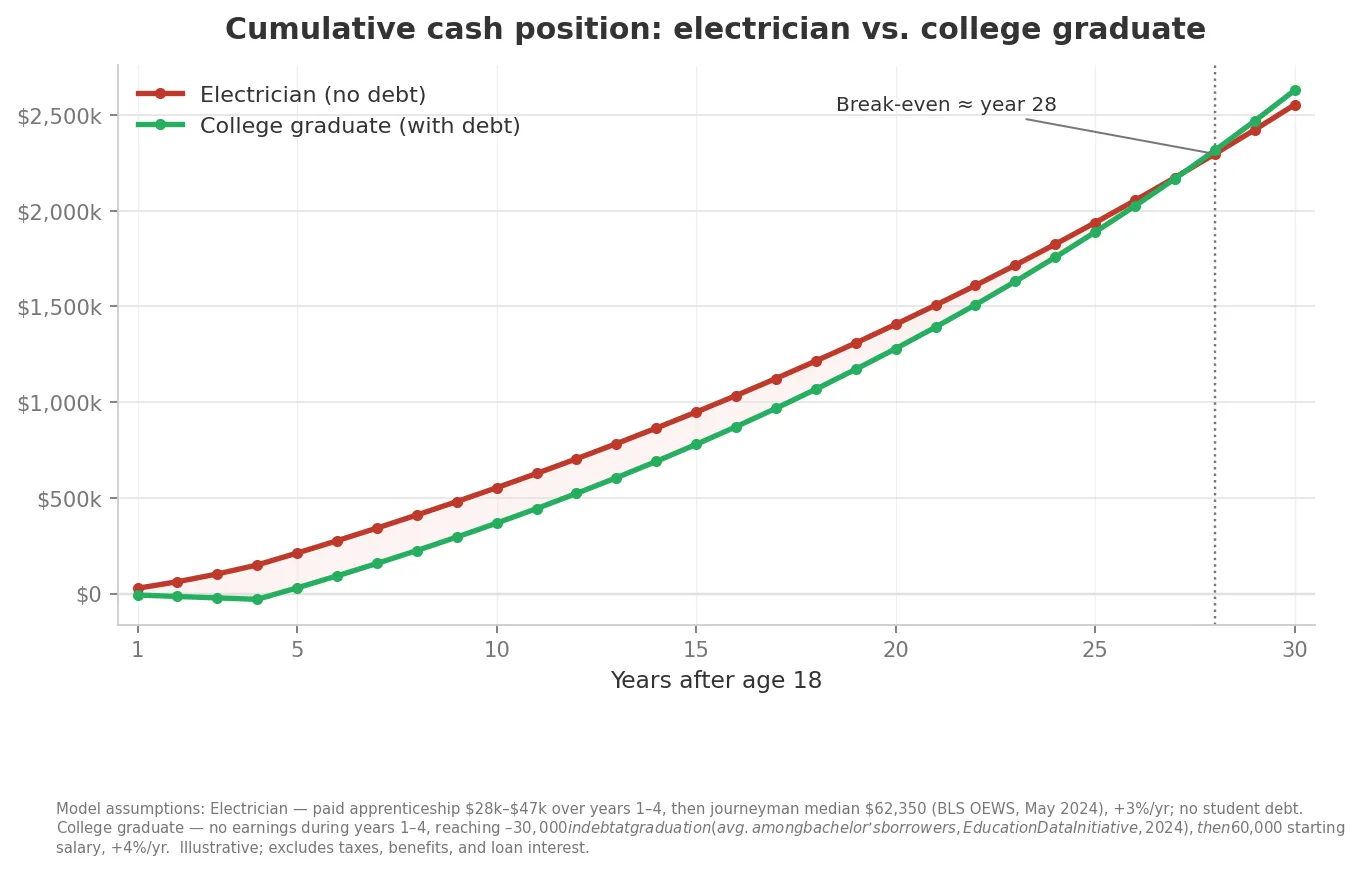
The prospects are more favorable than most 18-year-olds realize. An apprentice earns a paycheck from day one and finishes training debt-free, while a college graduate often starts their career $30,000 in the hole. That head start is a form of early capital most graduates never get: years of debt-free earnings that can be saved, invested, or put toward a business of one's own.
Demand Nobody Planned For
The retirement problem was foreseeable. What's harder to account for is the sudden demand from multiple sectors at the same time. Data center construction, EV infrastructure, and more are peaking in demand simultaneously.
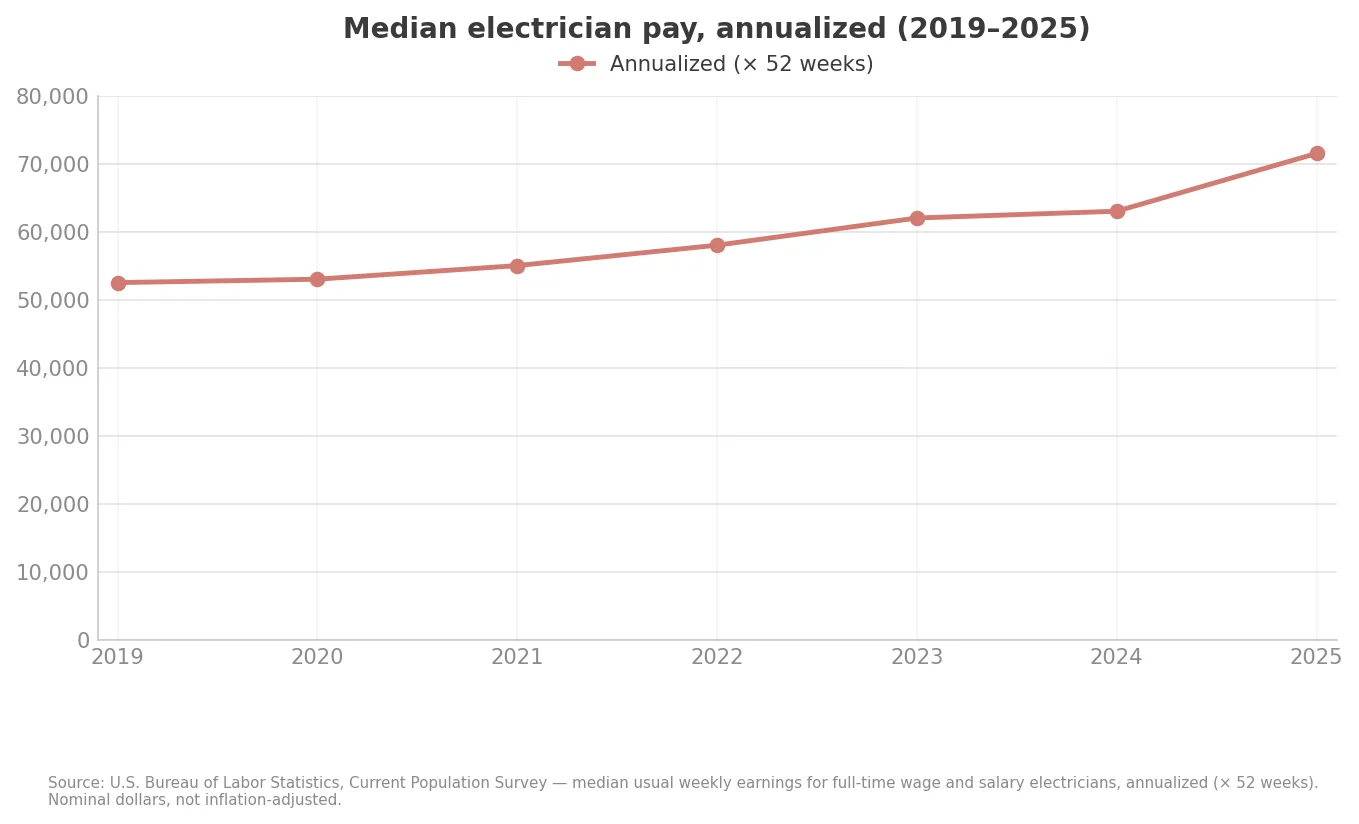
That surging demand has pushed electrician pay steadily upward over the past several years:
What It Costs for Contractors, Customers, and the Grid
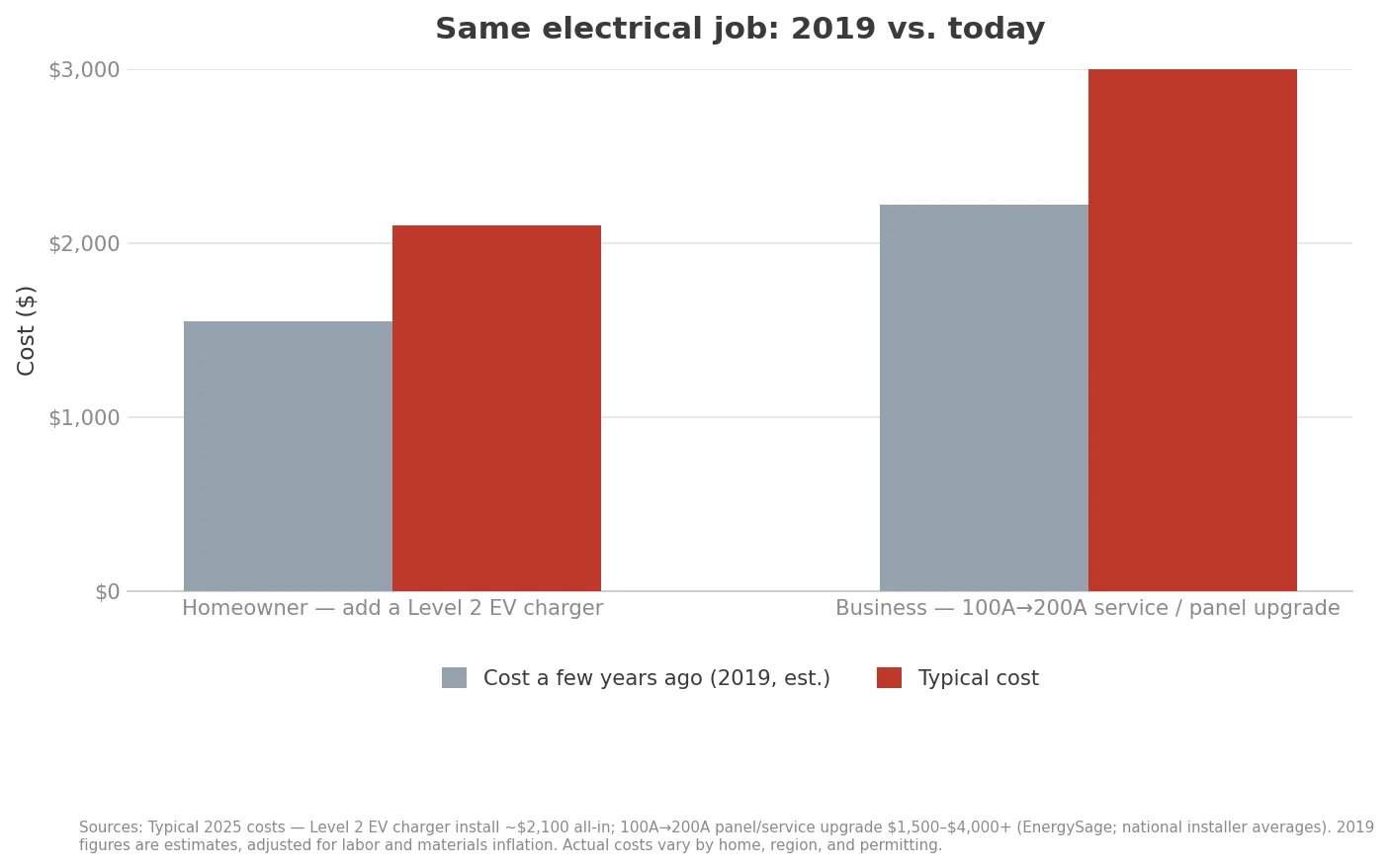
Labor shortages in skilled trades don't just slow things down. They make everything more expensive, and they carry real risk.
For Contractors
Contractors are caught between rising labor costs and fixed-price bids. In the tightest markets, shops are bidding against one another for the same few journeymen, driving wages and benefits up faster than they can rebuild those costs.
There's also one more pressure valve: subcontracting. The electrician at NJ Home and Power LLC described turning down jobs he can't staff fast enough, and leaning on subs to keep the rest moving. "You have to roll the dice on the subcontractor and hope they can do the work at your level of quality and cleanliness," he said. Increasingly, he added, keeping the work means "a lot of your business relies on subbing the work out," and betting your reputation on someone else's crew.
For Customers
On the customer side, whether it's a business doing a panel upgrade, or a developer building out commercial space, things are getting more difficult. The shortage means longer waits, higher prices, and sometimes jobs that simply don't get done. If you're planning to install a control panel, Blitzpanel can help you avoid delays and control costs with fast, quality engineering from our panel factory in Austin, Texas. Book a consultation with us here.
For Safety
There's a quieter cost, too: quality. When crews are stretched thin and timelines get compressed, mistakes slip through, and electrical mistakes aren't cheap to fix. It's part of why more contractors and integrators are pulling control panel work off their own plate. A panel that arrives already designed, built, and tested to spec is one fewer place for a rushed crew to make a costly error. See how Blitzpanel does it.
Becoming a licensed electrician typically takes four to five years through an apprenticeship program. That's a long runway. Programs can't simply scale up overnight: they need instructors, who are themselves in short supply, and they need employers willing to take on apprentices. Filling the workforce with electricians takes time.
There are structural issues, too. Apprenticeship programs vary widely in quality. Some JATC (Joint Apprenticeship Training Committee) programs have long waitlists; others struggle to fill seats. The gap between those extremes is part of the story.
This training is where a lot of would-be electricians fall off. "They like the idea of becoming an electrician," the NJ Home and Power electrician said. "They don't like the process of becoming an electrician." His diagnosis is blunt: "There's no instant gratification in the trades."
What's Being Tried and What's Working
The industry isn't standing still. A few approaches are showing real results; others are still finding their footing.
Reaching workers who don't know the trade. Some programs target veterans through initiatives like Helmets to Hardhats, which connects transitioning service members with registered apprenticeships. Others are working with high schools to introduce electrical work earlier, before students have already committed to a college path.
Broadening who gets recruited. Women make up a small fraction of the electrical workforce, typically under 3%. Programs focused on recruiting and retaining women in the trades have grown.
Paying up. Apprentice wages that would have seemed high a decade ago are now baseline in competitive markets, and some contractors are layering on benefits, signing bonuses, training stipends, and flexible scheduling that the trade historically didn't offer.
The Bottom Line
The electrician shortage is structural, not cyclical. It was built over decades by a training pipeline that couldn't keep pace with retirements, a cultural narrative that steered people away from the trades, and demand that has now outrun even optimistic projections.
Closing the gap is possible, but it requires more people choosing the trade earlier, programs that can train them at scale, and contractors willing to invest in apprentices who won't be fully productive for years. None of that is fast.
In the meantime, the work that depends on licensed electricians is waiting on a workforce that isn't there yet.
Blitzpanel designs and builds UL-certified electrical control panels — fast, with clear pricing and no shop handoff. Start a project with Blitzpanel.
FAQ
What is Blitzpanel? Blitzpanel designs and builds UL-certified industrial control panels. Our model is built for speed and clarity: transparent pricing up front, fast turnaround, and no shop handoff, so the panel you spec is the panel that gets built and shipped. For the contractors, integrators, and manufacturers navigating the labor crunch described above, that means one less bottleneck between a project and the day it goes live.
Is the electrician shortage real, or is it a media talking point? It's real, and the data backs it up. The Bureau of Labor Statistics projects about 81,000 new electrician openings per year through 2034, and most of those openings exist to replace workers who retire or leave the trade, not just to meet new demand. The pipeline of new electricians isn't keeping pace.
Why don't more people just become electricians? Becoming a licensed electrician takes four to five years through an apprenticeship program. That's a significant commitment, and most people making career decisions at 18 or 22 don't have a clear picture of the path, the pay, or the work. Perception has been a bigger obstacle than access in most markets.
How much do electricians make? The BLS reported a median annual wage of $62,350 for electricians in May 2024, but that understates the range considerably. Journeymen in high-demand markets often earn $80,000 to $100,000, and foremen and master electricians running their own businesses can earn well above that, with no student debt.
Is the shortage worse in some regions than others? Yes. Markets with heavy data center construction—Northern Virginia, Texas, Phoenix—are among the most acute. But the shortage is national, and rural markets often face the added challenge of having fewer apprenticeship programs nearby.
What's the connection between the electrician shortage and control panels? Every industrial control panel needs to be installed and maintained by licensed electricians. When those workers are scarce, panel projects stall, commissioning gets pushed out, and the downstream equipment sits idle. The shortage is an upstream constraint on a lot of industrial work.
Glossary
Apprenticeship. A structured, paid training program that combines on-the-job work with classroom instruction. The standard path to becoming a licensed electrician in the U.S., typically lasting four to five years.
Journeyman electrician. A licensed electrician who has completed an apprenticeship and can work independently. The core of most electrical crews.
Master electrician. A senior license in most states that allows an electrician to pull permits, run a business, and take responsibility for a project's electrical work.
JATC (Joint Apprenticeship Training Committee). The joint body of contractors and unions that runs apprenticeship programs in unionized markets.
NECA (National Electrical Contractors Association). The trade association representing electrical contractors in the U.S.
IBEW (International Brotherhood of Electrical Workers). The union that represents most of the unionized electrical workforce in the U.S. and Canada.
Helmets to Hardhats. A nonprofit program that connects military veterans with registered apprenticeships in the construction trades, including electrical.
UL508A. The standard for industrial control panels in the U.S., covering design, construction, and testing requirements.
Resources
IO List Template
Get the free IO list template →
Build Your Control Panel
Start a project with Blitzpanel →